
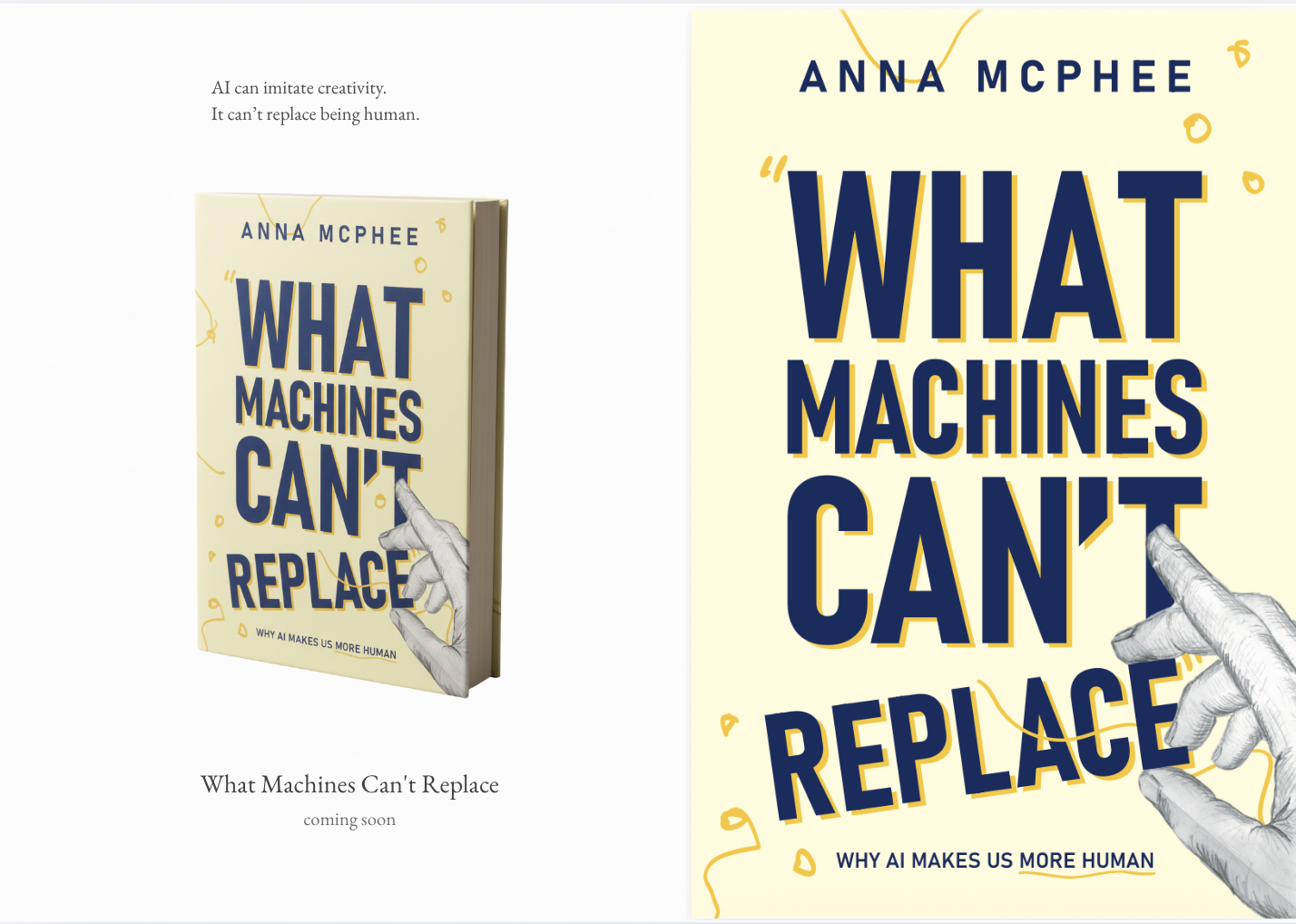
The ebook for What Machines Can’t Replace is scheduled to publish in August, 2026. I still feel a little giddy each time I type those dates.
You can find the book at whatmachinescantreplace.com, and pre-orders are open now for ebooks on Amazon, Barnes & Noble, Apple books, and Kobo. Print pre-orders are coming soon.
The book is about what humans bring to creative work in an age of AI, and specifically about why the more capable machines become, the more fiercely people seem to want the things machines can’t do. I came to this question as a developer who builds AI tools by day and then goes home and makes stock from scratch and seeds a garden by hand, and I pondered a lot about why both things felt necessary.
The research is in there, the psychology and the neuroscience, and through the book we get introduced to some truly fascinating people. In January 1975, Keith Jarrett arrived at the Cologne Opera House to find the wrong piano waiting for him: a small, tinny baby grand with broken keys, completely inadequate for the concert he had planned. He walked onto the stage anyway, sat down, and played for over an hour. That recording became the best-selling solo piano album in history. There’s also Han van Meegeren, a Dutch painter whose original work the critics had dismissed as derivative, who spent a decade perfecting forgeries so convincing they fooled the greatest art experts in the world, and only got caught because a Nazi war crimes investigation needed to trace a painting’s provenance. And there’s Mio Heki, a kintsugi master in Kyoto who repairs broken ceramics with gold lacquer, working under precise humidity conditions, transforming objects that are broken into something that couldn’t have existed without first being broken.
The chapters cover the psychology of effort and why shortcuts feel hollow, imperfection as a signal of authenticity, the uncanny valley in AI-generated writing and art, what happens to creative flow when AI absorbs the hard parts of a task, and how to build a creative practice that stays yours. I wrote it to be argued with as much as agreed with, and there are conversation starters at the end of every chapter if that’s your kind of thing.
If you want a taste of it before committing, there’s a free sample chapter at whatmachinescantreplace.com/read.
Now, the part where I ask for things.
ARC readers
If you’re willing to read an advance copy and leave an honest review on Amazon by launch week, I can send you an ePub copy ahead of the ebook release. Get in touch using the form below.
Blurbs
If you have a job title or role you’d be comfortable putting next to your name, and you’re willing to put two sentences about the book on the record, please reach out. Two sentences is genuinely all I need.
Foreword
This is the long shot. If you know someone who works in AI, creativity, ethics, or human-centred technology and who might be the kind of person who writes forewords, I would love a name to start with. I’ll do all the asking. It doesn’t need to come together for the book to happen, but it would be wonderful if it did.
The best way to reach me is hello@anna.kiwi. And if you just want to know more about the book, I’m happy to talk about it at length, because I have not run out of things to say. You can also reach me using the contact form below.
Get in touch
Whether you’re interested in an ARC copy, a blurb, or you have a foreword lead — use the form below. Let me know which one (or more than one).


Leave a Reply