After years of wandering, Mexico captured my heart in ways I never expected. From the vibrant markets of Oaxaca to the coastal magic of Puerto Vallarta, I’ve found myself returning again and again to explore the incredible depth of Mexican culture, food, and warmth. These posts chronicle my ongoing love affair with a country that taught me what it means to truly savor life.
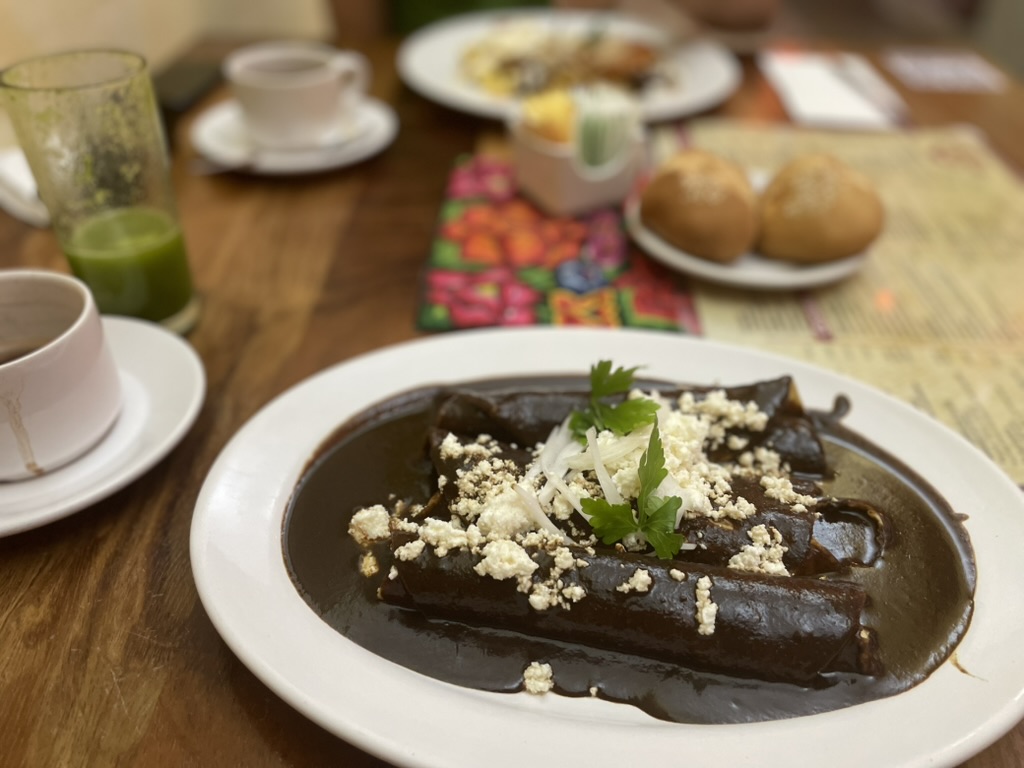
I’ve been collecting these photographs across more than a decade of visits to Oaxaca, starting from my very first trip in May 2013. When I look at them now, the textures and colours transport me immediately – those distinctive Oaxacan tablecloths, the hand-painted dishes, the flowers scattered in the background. I can taste the flavours all over again.
What surprised me most, initially, was learning about the pre-Hispanic heirloom corn varieties. I knew corn was important to Mexican cuisine, of course, but discovering these ancient varieties – criollo corn in deep purples and reds, some nearly black – opened my understanding of how fundamentally different Oaxacan food is from Mexican cuisine elsewhere.
The moles here aren’t what you’d expect if you’ve only tasted Mexican food outside of Oaxaca. The complexity is extraordinary – some require over twenty ingredients, ground by hand on volcanic stone metates that have been used for generations. I remember watching abuela after abuela working their way through the process, each family recipe slightly different, each one a masterclass in patience and technique.
These photographs capture something I find difficult to explain to people who haven’t been here. The way morning light falls across fresh tortillas still warm from the comal. The deep, earthy red of chile chilhuacle negro. The satisfaction of eating food that tastes exactly as it did centuries ago, prepared with the same care, the same reverence for ingredients that grow from this particular soil.
Looking through these images, I’m reminded why I keep returning to Oaxaca, why the flavours here have become such an important part of my understanding of what food can be when it’s deeply rooted in place.
Oaxaca city is full of wonderful markets bursting with amazing produce. Many of them are unassuming, tucked away through a doorway, down an alleyway, or around the corner. Access to fresh & delicious produce is one of my absolute favourite things about living in Mexico.
Before you go: produce markets in Oaxaca
I’m yet to find a mercado that’s disappointed me, they all have excellent produce for sale. I’d recommend visiting a few different ones to get a feel for it, but ultimately the one closest to where you are living or staying is probably going to be the best choice.
This is far from a comprehensive guide! But a couple of my favourite mercados (markets) in Oaxaca Centro are:
Mercado Sánchez Pascuas
Mercado Organico la Cosecha
Mercado de la Merced
Mercado de abastos
Mercado Centenario
At the market: buying your produce
Once you’ve decided which vendor to shop from, the next step is choosing what to buy. They will have a stack of some kind of basket or plastic tub for you to take one, and fill it with the fruits and vegetables you want.
Now is the fun part – choosing what you want to buy from the many piles of gorgeous looking fruits and vegetables. I always come home with so much more than I planned, because all of the wonderful produce is so tempting! So get to work, filling up your basket.
Sometimes, certain things like fresh herbs will be behind the counter. So if you don’t see what you want right away, don’t be afraid to ask!
One your basket is full, hand it to them and they will weigh up, count, and work out the price for you. If you struggle with Spanish, they will almost always have a pen and paper or a calculator to write the total down for you as well.
At the market: some useful words & phrases in Spanish
Although you may come across vendors who speak some English, a large majority of them will not. And besides, your visiting one of the most beautiful and traditional parts of Mexico – so using one of the local languages is not only part of the experience, but it’s part of being a considerate guest!
Estoy buscando / I’m looking for
¿Tienes …? / Do you have … ?
Necesito una bolsa / I need a bag
No necesito bolsa / I don’t need a bag
¿Cuánto cuesta? / How much is this?
¿Cuánto va a ser? / How much will it be?
¿Aceptan tarjetas de crédito o débito? / Do you take credit or debit cards?
¿Tiene cambio de un billete grande? / Do you have change for a large bill?
¡Muchas gracias! / Thanks very much!
aguacate / avocado
tomate / tomato
cebolla / onion
tomatillo / tomatillo
plátano / banana
manzana / apple
frambuesa / rasberry
mora / blackberry
arándano / blueberry
fresa / strawberry
papa / potato
toronja / grapefruit
naranja / orange
limón / lime
champiñón / mushroom
zanahoria / carrot
ejote / green beans
mango / mango
guayaba / guava
piña / pineapple
carambolo / starfruit
lechuga / lettuce
espinacas / spinach
pepino / cucumber
rábano/ radish
At the market: what does produce cost in Oaxaca?
The pricing for produce here is quite different from the USA, New Zealand, or Canada; for example. I love arriving into Mexico and enjoying the abundance of fresh, seasonal, and locally grown produce. But what does it cost? Here’s a breakdown of my most recent produce trip to the mercado:
Total price: $269mxn (at the time of writing in 2022 this is $12.79USD)
Once you get home: preparing your produce
Many of the things that make produce in Oaxaca so darn wonderful also make it a little problematic to eat right out of the bag. This is not a situation unique to Oaxaca, and is something you will encounter right across Mexico.
Everything is grown locally, often organically, and fertilised here in the Oaxaca valley with cow manure. Once it arrives at the mercado, as well as during the journey, it’s often sitting on the ground, in the dust, or on dirty truck beds and mercado floors. The dirt and bacteria that produce collects can make many people sick, so it’s important to prepare your produce properly – like locals & restaurants all do.
How to prepare fresh produce from the market in Mexico. This is done right when you get home from the mercado, before putting them away into the fridge and cupboards! It can take a little time, but it’s worth it to know all of your fruits, vegetables & salads are safe to eat right off the shelf.
Trim & shake
Shake off any visible dirt, and trim off things like roots, old leaves, and any parts of the fruit or vegetable which look undesirable/bad. It’ll go a long way to cleaning them if the dirt is already off!
Rinse them off
Take your produce and give them a rinse off in some water to get any loose dirt and particals off, it doesn’t need to be purified water at this point – under the tap is just fine
Soak & Sanitise
You can buy microdyn from just about any supermarket, and many mini-marts and oxxos. It’s a disinfecting liquid, and you add a few drops to a bowl of water, then put in your produce to soak. I tend to leave things up to 15 minutes – especially those which collect a lot of dirt and don’t have a peel or skin, such as lettuces and fresh herbs.
Some fruits in particular such as rasberries and strawberries can become waterlogged, so in those cases I soak them a bit less and/or use a separate citrus seed oil spray on them.
Drain & dry
Once they are finished soaking, leave them to dry. I like using a drying rack, or a colander. The most important thing is to place them somewhere clean, and not right back on the surface you were preparing the pre-soaked produce on.
Into the fridge and onto the shelves!
Now, place your produce however you like to store them. It doesn’t matter how, the main thing here is that you don’t put them back into the bags or containers they arrived in unless the containers have also been thoroughly washed & sanitised. Otherwise you will just be undoing all your hard work!
Towards the end of 2021 I moved to Puerto Vallarta for four months. It was far from my first time in Mexico, but It was my first time in this city as well as the state of Jalisco. When I move someplace new, one of the first things I want to know is an overview of the different neighbourhoods. The various barrios, or Puerto Vallarta neighbourhoods, have distinctly different vibes. So I got together with a few other bloggers who know Puerto Vallarta well to create a guide to the different areas most commonly inhabited by tourists and expats.
Puerto Vallarta is a city in the state of Jalisco. It’s on the Pacific Coast of Mexico, just below the Baja region, not too far south of Mazatlan and straddling the state of Nayarit. It’s picturesque – where the ocean meets lush green jungles & the Sierra Madre mountain range. It’s an excellent place to see whales, enjoy the ocean, and taste some typical Jalisco food.
There are of course, many many more barrios than those mentioned here! These are just the ones you are most likely to encounter when checking out hotels, airbnb, or rentals geared towards foreign expats. If you know Puerto Vallarta well, and would like to contribute a neighbourhood to this guide that’s not already covered, let me know! I’d be happy to include you.
Puerto Vallarta is a bit of everything – tourist mecca meets traditional Jalisco life,
Centro
Recommended by Vicky of Buddy The Traveling Monkey
One of our favorite neighborhoods in Puerto Vallarta is the “Centro” neighborhood. It’s nestled between the “5 De Diciembre” neighborhood and the “Zona Romantica” neighborhood. Centro has a very high-energy vibe. It’s perfect for those wanting to experience Puerto Vallarta’s lively and bustling scene.
In Centro, you will find Puerto Vallarta’s malecon, a stone boardwalk that is approximately one-mile long. There are always people walking, jogging, or biking on the malecon. There are usually food and craft vendors too. It’s a great place to people watch! A lot of the free things to do in Puerto Vallarta can be found in Centro as well. The Church of Our Lady of Guadalupe is an iconic landmark and free to enter. You can also visit the ChocoMuseo. This free museum tells all about the history of chocolate. Centro also has a lot of great restaurants and bars. If you love seafood, definitely head to Restaurant El Malecón. It’s on the beach and a great place to watch the sunset.
Zona Romantica (aka Romantic Zone or Old Town)
Recommended by Sarah from Live Dream Discover
The Romantic Zone is aptly named as it is the heartbeat of Puerto Vallarta. Here the narrow cobblestone streets are alive with tourists, ex-pats and locals enjoying the many restaurants, bars and shops in the neighborhood. It’s safe to say that every visitor to Puerto Vallarta will spend time here. This is also the home of Los Muertos beach, the most popular beach in Puerto Vallarta. Of course, this means it’s not the most peaceful beach in PV. But if you enjoy a lively atmosphere created by people of all ages along with watersports, beach activities, vendors and beachside bars you’ll love Playa Los Muertos.
A walk on the iconic pier is another must on this beach. By day, top things to do in Zona Romantica include lunch on Olas Atlas (Café Street), shopping at Olas Atlas Farmer’s Market and Isla Río Cuale Flea Market and of course enjoying the beach. After dark, the neighborhood becomes even livelier with the sound of music and people enjoying the many bars, clubs and entertainment venues.
The Romantic Zone is very gay-friendly with several bars catering to the LGBTQ community who love Puerto Vallarta. For a lower-key evening there’s great live entertainment at Act II Theatre and Incanto. Accommodations in Zona Romantica tend to be small boutique hotels, vacation condos and guest houses. This is not the place to stay if you want large luxury, all-inclusive resorts. There are also quite a few residences here housing ex-pats and locals.
Gringo Gulch
At first glance, the name of this Puerto Vallarta neighbourhood catches people off guard! But despite how it might seem, Gringo Gulch was a name given to the area by the Gringos themselves, and is not considered anything negative. The barrio is made up of a little stretch of houses just up the hill from Centro, running along the Rio Cuale.
Here you will find some more traditional housing dotted amongst some incredibly luxurious villas. This is where Elizabeth Taylor and Richard Burton had their house Casa Kimberly; which is now a fancy hotel & restaurant you can visit.
Gringo Gulch is beautiful, a little hilly, but with excellent views and close proximity to lots of restaurants and all the action of Centro Vallarta & Zona Romantica.
There are not many restaurants here, just housing and holiday villas. The main dining attraction here is the Iguana Bar at Casa Kimberly, this former house of Elizabeth Taylor and Richard Burton offers fine dining, stunning views, crystal chandeliers, and a top-notch tequila bar.
Gringo Gulch is a beautiful neighbourhood to stroll around, a haven of cobblestone roads, tiny staircases winding up the hill and blossoming bougainvillea. From here, you can easily get down to the beach in just a few blocks; walk over to Cerro and up to the Mirador el Cerro de la Cruz from here for amazing sunset views; or down the Puente Iguana stairs to the Rio Cuale Island, and across to Zona Romantica for plenty of restaurants, bars, and things to do.
El Cerro
El Cerro means ‘The Hill’ in Spanish, and it’s a fair descriptor for this Puerto Vallarta neighbourhood! Cerro is just up in the hill behind Centro next to Gringo Gulch, and is part of Puerto Vallarta’s original old downtown. Despite being a quick and simple walk down to Centro, it feels like stepping into a small town. The bustle fades away, and is replaced with roosters cawing and the sound of kids playing in the street.
Cerro is where we rented for 3 of the months whilst we were based in Puerto Vallarta and I’d recommend it for the old-town Mexico vibes, incredible views, and the convenient location. Most of the restaurants around here are technically down in Centro, but there are some amazing finds up here if you know where to look. Restaurant & Bar El Panorama, the famously extravagant Café des Artistes, and Restaurante Barcelona are all excellent restaurants in the area.
Cinco de Decembre
Introduced by Bailey from Destinationless Travel
One of the best neighborhoods in Puerto Vallarta is 5 de Diciembre (or 5th of December.) This area is the perfect place to base yourself in Puerto Vallarta thanks to its central location and stunning beach. 5 de Deciembre is located just north of Centro and the Malecon in Puerto Vallarta. This location means that you are still within a vibrant and safe area with easy access to some of the best attractions Puerto Vallarta. You can walk to the Malecon in only a few minutes, which is one of the busiest tourist areas in the city. But 5 de Deciembre is also a lot calmer than other neighborhoods in Puerto Vallarta like Centro or Zona Romantica.
There are fewer people around and the beach, Playa Camarones, is always much more peaceful with fewer crowds and vendors. In fact, Playa Camarones is a favorite beach in Puerto Vallarta with both tourists and locals. It is clean and beautiful with epic sunsets. Some of the best restaurants in Puerto Vallarta are located in this area too. For a fancier seafood meal, you cannot miss El Barracuda. Located right on the beach this place has the best location. But besides that, the food is very tasty with a variety of creative seafood dishes to choose from made with locally sourced ingredients.
El Remence / Las Canoas / Buenos Aires / El Caloso / Las Penas
Tucked away in the hillside behind Emiliano Zapato, you’ll find a cluster of small Puerto Vallarta neighbourhoods which on first sight, feel much less touristed than their nearby counterparts. These small barrios share a similar vibe which is much more laid back. They are still popular with expats and tourists, and most Mexicans I’ve talked to have sadly described them as rapidly gentrifying.
Whilst still a very quick stroll to Zona Romantica or Centro, the feeling here is much more small-town, friendly, and relaxing & through the hotter seasons much of life here is lived sunbathing, picnicking and swimming in the Rio Cuale river.
Las Canoas is where I lived for my first month in Puerto Vallarta, and I will readily recommend it to anyone as an excellent barrio to stay in. There are plenty of smaller restaurants and street food vendors here, and if you’re looking for more it’s a very quick and easy walk over to Emiliano Zapato where much of Puerto Vallarta’s best food can be found.
Amapas
Sometimes described by locals as the “Hill of Airbnbs”, Amapas sites just south of Zona Romantica but before you reach Conchas Chinas. It’s the hillside on the South of Centro, looking over Zona Romantica and is full of gorgeous AirBnBs.
Much like Conchas Chinas, there is not much else here to do or to eat, but you have close access to all of the wonderful restaurants in Emeliano Zapata, and some stunning coastline to gaze into. Many of the accomodations here are more modern, and less traditional. You’ll find plenty of pools and patios with amazing sunset views.
One highly recommended restaurant in Amapas you’ll be close to, however, is Hot Mamma’s Whiskey Kitchen – which has many well earned good reviews thanks to their excellent fried chicken.
Emiliano Zapata
The barrio of Emiliano Zapata is named after the revered Mexican revolutionary, and is the original old town of Puerto Vallarta. Some people call this interchangeably with the ‘Old Town’ or ‘Zona Romantica’ but it’s a little more nuanced than that. This is why I have them as two separate neighbourhoods here.
Whilst the entirety of Zona Romantica lies inside Emiliano Zapata, there are a number of blocks inland which are not really considered Zona Romantica at all. So could could say that the Zona Romantica is a section inside the wider area of Emiliano Zapata.
As you head in towards the Rio Cuale from Zona Romantica, things will start to feel less touristed and more local. The food gets better, more Spanish is spoken, and in my opinion this is one of my favourite parts of Puerto Vallarta.
If you’re on the lookout for an authentic foodie experience, and a spot close to the action without being right in it, this inland part of Emiliano Zapata is an excellent choice. Try Marisma Fish Taco & Balam Balam for great fish tacos, Red Cabbage Café for food themed around what was served at Frida Kahlo & Diego Rivera’s wedding dinner, and Carnitas Lalo in the morning for the best carnita tacos (a typical breakfast food, unbeknownst to many visitors!)
Conchas Chinas
Recommended by Noel Morata with Travel Photo Discovery
Playa Conchas Chinas is on the far side of Puerto Vallarta’s beaches and is truly a gem because it is more isolated then the main beach lining up the large malecon of the city. Also to get to the beach is an Uber ride or bus ride and you actually have to hike down directly to the beach area from the main highway on top. The beaches here are mostly small coves with giant rocks and gorgeous views of the rests of the coastline north and south of the city.
These beaches are not so busy, so you can easily find your own perfect spot to lounge and enjoy the ocean mostly on your own and without any crowds. Vibe is low key with condos and homes in the area and just a few restaurants by the highway on top, so there is really not much of a neighborhood to stroll and enjoy unless you opt for any of the ocean views from the restaurants above. There are also no hotels but maybe Air Bnb rentals in the area so there are no crowds flocking to this beach.
The few restaurants here cater to a mostly affluent residence and dinner is the prime time to eat. Since I was there just a few hours I didn’t get a chance to eat at Conchas Chinas but took an Uber ride back to the main tourist zones of Zona Romantica to find a lot of choices in food venues. This area is definitely off the beaten path with beautiful sandy coves far away from crowds, so if you are looking for something unique, gorgeous coastline scenery and hardly any visitors, then you should check out this beach area and enjoy a fun day in the sun in south Puerto Vallarta.
Fluvial
The barrio of Fluvial backs onto the hotel zone, and is an upscale residential area bordering the Pitillal River. What it lacks in tourist activities, it more than makes up for with an abundance of shops, schools, and dining options. From here you have great access to Costco, Plaza Caracol, Macroplaza, and the Food Park PV food court.
There are also many more townhome style accomodation options compared to most of the barrios mentioned in this post. So if you’re looking for a house, rather than a condo, with great accessibility to shops and services, Fluvial is a good spot.
For eating here, you have an abundance of choices. The well known brunch spot Fredys Tucan has a branch here, and the Food Park PV has a selection of awesome food vendors.
Zona Hotelera / Hotel Zone
Introduced by Lora from Explore With Lora
Puerto Vallarta’s Hotel Zone is where you’ll find some of the top hotels right on the beach. If you’re visiting for the first time and looking for a safe, family-friendly area with lots of amenities, then this may be a good area to stay. Since it’s mainly for tourists, most expats don’t typically live in this area. Within the hotel zone, there are an abundance of beautiful hotels, resorts, and modern apartment buildings stretching along the golden-sand beaches.
While it includes top rated hotels such as the Sheraton Buganvilias, there are also accommodation choices to suit any budget. The location is convenient, just a 15-minute from the airport and 10-minutes from downtown. The beach will be right outside your door, with ample opportunity for water sports. Since Puerto Vallarta isn’t that large of a city, you can actually walk to several of the other neighborhoods from the Hotel Zone. Versailles is nearby, where you’ll find some of the best local restaurants in the city.
Zona Hotelera Puerto Vallarta
Versalles
If I were to move back tomorrow, and had my pick of all the different Puerto Vallarta neighbourhoods; Versalles would be where I would choose now. It’s a little off the tourist trail, but still very close to the beach. You can walk to the nearby 5. de Dec. neighbourhood easily from here, and it’s a short Uber ride to Centro and Zona Romantica.
The thing I love most about Versalles is the feeling – it feels more like normal Mexico life. It is, however, rapidly gentrifying so things may be incredibly different in 5 or 10 years time. It does mean though that modern condos are popping up all around, and there are some excellent restaurants and brunch spots to check out.
Some crowd favourites to dine are Puerco de Oro for the best pork belly tacos in town, Tortas Ahogadas Tony for the best tortas ahogadas (a Jaslico speciality) around, and Cha’ for a legendary brunch.
Marina Vallarta
Marina Vallarta is the Puerto Vallarta neighbourhood closest to the Airport, and is home to a number of large resorts such as the Westin & the Marriott. If you’re heading out on one of the many, many boat tours available they will most likely leave from here, too.
Accomodations around here can be a little pricier than other parts of town, but they are also quite modern and have close access to the marina, beaches, and golf course. This draws a lot of foreigners in, so you will find many expats and a lot of English spoken around the Marina.
One of the main attractions of Marina Vallarta is the weekly night market, which happens every Thursday evening. And to eat, Mr Cream is a well known brunch spot, with some of the best pancakes in Puerto Vallarta, but be prepared to queue! Victor’s Place Cafe Tacuba is another waterfront spot with excellent enmoladas.
Neuvo Vallarta
Introduced by Claire from Claire’s Itchy Feet
Nuevo Vallarta is a bit like the Cancun of Riviera Nayarit. It’s split into 2 very distinct areas, the hotel zone and gated communities on one side of the highway. And the more local area across the other side of the highway. I’ve been living in Nuevo Vallarta for over a year now and have lived on both sides of the highway. The hotel zone is a super safe area full of large resorts, gated communities, nice restaurants, and lots of green spaces. It’s well connected by collectivos (small local buses) and easy to walk or bike pretty much anywhere. Unless you are staying in one of the resorts, it can be tricky to find one of the few public access points to the beaches, but they do exist. There is a bike lane running the full length of Nuevo which will take you right up to neighboring Bucerias.
Most people who vacation here are staying in one of the all-inclusive resorts. But it is also a popular area for medical and dental tourism, with some of the best Drs in Mexico practicing here at the private hospital. For expats and remote workers, what’s great about Nuevo is that the rent is lower than in Puerto Vallarta and you get a lot more space (both indoors and out). The WiFi is strong and fiber optic is common. It’s close to surfing beaches but still only 15 minutes from the airport. Most ex-pats who live here either live in one of the secure housing estates at the entrance to Nuevo Vallarta hotel zone in the Jaretarreras area, or over the other side of the highway in Valle Dorado.
Some of my favorite places to eat in Nuevo are Doña Raquel’s (just off the roundabout as you enter Nuevo by OxxO opposite El Tigre) it’s a small local restaurant with the best Pozole! Her husband is from the USA and they also have Chicago-style ribs and some other classics. For breakfast I’m obsessed with Paninnos, make sure you try their cinnamon rolls. And if you want a healthy lunch then try Organi-K down by the marina.
El Pitillal
Many visitors to Puerto Vallarta never see el Pitillal, a small town in its own right surrounded by Puerto Vallarta. It’s only 20 minutes driving away from the more well known parts of Centro Puerto Vallarta, but has the feeling of small town, traditional Mexico.
Located North east of the Hotel Zone, just near Fluvial, el Pitillal is a great place to experience a more typical style of life in the state of Jalisco. Whilst not much of a tourist stop, it’s a good place to see where many of the people who work in Puerto Vallarta live, shop, eat, and enjoy their free time. And if you speak some Spanish, it’s a great place to enjoy a less tourist driven way of life.
El Pitillal is the perfect spot to enjoy the delicious regional specialities of Jalisco, such as tortas ahogada & birria, and find traditional clothing, handicrafts, art, and performances.
I am many different things, but three of the most prominent of those are an avid researcher, borderline obsessive foodie, and Mexico fangirl. This cocktail means that I arrived back in Mexico armed with an enormous amount of lists, mostly centered around where (and what) to eat in Puerto Vallarta.
Having spent most of my previous time in Mexico based out of Oaxaca, I was prepared for the food to be different. Jalisco is famed for tequila, birria & torta ahogada; quite the change from the lands of mezcal, chocolate, & mole I’d come to know.
To say I was eager was an understatement. Armed with my encyclopaedia-reminiscent lists, and guided by what was nearby in barrio Las Canoas where we were to start our adventure. So in this edition, the restaurants are all around the Emiliano Zapata (Zona Romántica), Centro, and 5 de Diciembre areas.
Without further ado, here are the best restaurants I tried in my first month of Puerto Vallarta.
A Handy Map of Restaurants in Puerto Vallarta
In case you’d like to try any of the places mentioned in this post, you can find them all in the map below:
I did my research, and Marisma was touted as one of the best fish taco spots in town. This made it one of my first stops after a number of years away from Mexico and yep, I would agree – excellent fish tacos. My favourites still come from Puerto Escondido, but these are a perfectly wonderful alternative.
Marisma has a well priced menu of baja-style fish, and other seafood, tacos – but the real drawcard is the awesome selection of salsas that come along with them. I trotted down in the mid afternoon and was treated to the whole stall to myself – but be warned, this place is popular and I hear amasses quite the queue around mealtimes.
Baja style fish tacos from marismo fish tacos in Puerto Vallarta
We arrived into Puerto Vallarta in search of Chilaquiles – my favourite Mexican breakfast food. I’m still not convinced that anywhere does them as well as Oaxaca, but I was willing to have my mind changed. So, I did my research. Cuates y Cuetes came up as a perfectly excellent choice to not only eat some chilaquiles, but also curl my toes into the sand & hear the ocean lapping whilst I did so.
Since that first visit, we’ve been back here more often than just about anywhere else. The view is amazing, the staff are unbeatable, and they make an excellent margarita. I love to bring guests to Puerto Vallarta here, and continue to recommend it.
A newcomer to the far, top end of Zona Romantica, Fonda el Cucon was one of the most convenient restaurants to our AirBnB in the Las Canoas neighbourhood. Immediately, we were welcomed like locals. Ever since, we’ve been welcomed back as friends. The food is wonderful, and I cannot recommend this little spot enough. Great for any meal of the day, I am particularly fond of their red enchilada sauce.
Best tacos in town, as it turns out, is a completely subjective thing. But Pepe’s has my vote, every time. I especially love their Hawaiian on a crispy tortilla – just amazing. But so far, nothing we’ve ordered has been disappointing. The el pastor is worth the walk on it’s own. Open late, super quick, always delicious – no complaints from me!
Soco’s place is a small joint on the corner in the riverside corner of Emiliano Zapata. We only went their the one time, so I don’t have a lot to say. But the chilaquiles were great, and that’s all that really matters … right?
River Cafe is always bustling. Maybe it’s the placement right on the Isla Rio Cuale in the heart of the tourist zone, maybe it’s the wonderful live jazz. Most likely, it’s the gorgeous tranquil paradise they’ve created on the edge of the river.
The food here is fine – it’s good, but the real attraction is the atmosphere. Go here for the experience of being here and enjoy a hidden paradise amongst the bustling Centro city area.
El Banquito is a tiny lunch spot in the heart of centro, just off the beaten tourist trail. It quickly became a beloved lunch stop of ours, and now we eat there frequently. They are most known for their (excellent) birria tacos, however the cubano torta is well worth a taste.
We discovered this cute, typical taco stop when looking for somewhere closeby to Vallarta Cowork to eat lunch when we first came to town, and we’ve been back numerous times since. Be prepared to use your Spanish skills here, and don’t miss their awesome agua frescas, too.
After two years away from Mexico, one of the things I felt most in need of was a decent margarita. So, first thing – I got to work quizzing the local expat groups on where to find an excellent margarita.
I gotta be honest – the results were incredibly divisive.
Some people recommended margarita grill for an excellent margarita, the others dismissed it as super touristy and a bit gimmicky. Turns out, I think both are true. In any case, they do make a great margarita & the cochinita pibil is pretty wonderful too.
In search of pozole, my research led me to the base of the Parroquia de Nuestra Señora de Guadalupe, and to the unassuming traditional-style El Campanario.
Cheap, delicious, traditional – what’s not to love? I’ve been back plenty since – the pozole is excellent, the comida even better. Also, for somewhere so central, everything is remarkably affordable too. Since that first visit, we’ve continued to return to El Campanario many times.
Joe Jacks is an oft recommended dinner spot that popped up onto my radar numerous times. So, for a nice dinner out in the Zona Romantica we decided to check it out.
The upstairs terrace is charming, and the food was wonderful. They mix an excellent cocktail, too. The only downside is that is does get pretty busy in the high seasons, and is generally pretty full of tourists.
I’m a self professed Oaxaca obsessive. Mole is one of my favourite Oaxacan delicacies, and despite being in Jalisco I was still keen to track down some delicious Oaxacan cuisine. As it turns out, the opportunities to eat Oaxacan are slim in Vallarta.
But, luckily enough there is still one option, and they do make a few delicious different moles. Mole de Jovita didn’t quite stand up to my (unfairly high) expectations after living in Oaxaca, but it’s the best I’ve found in Puerto Vallarta, and I would gladly eat there again.
We found Los Muertos early on in our time living Puerto Vallarta as it’s only a few blocks from where we were based for the first month in Las Canoas.
Los Muertos brews some great beers, the El Duderino (a delicious vanilla java porter) being a personal favourite. They also make great (albeit massive!) pizza, and everything else I’ve tried on the menu has been good too.
This is an excellent spot if you’re looking for a beer and a momentary break from Mexican food, or if you’re just craving a slice of pizza!
Monzón was the second brewery we quickly checked out in our first few weeks in town. They also make really good beers, and I love how often they switch them out and try new things.. although I haven’t yet found anything I like quite as much as the El Duderino (mentioned above)
What I really love about Monzón is the tacos!
They are more US styled & priced than the kind you’ll find out on the street all about town, but gosh are they delicious! Right now I’m specifically enamoured by their baja fish, but the caramelized pork belly is pretty excellent too. Monzón very quickly became our go-to spot for a boozy Friday late lunch.
Right at the fartherest end of Emiliano zapata, right by the mercados & fruterias that border the rio cuale is Mariscos el Colera. We’ve only eaten there the once, but I can vouch for their fish tacos being excellent, and they mix up a mean raicilla margarita.
There are plenty of tables, it’s excellent for watching life go by in a less touristy part of an otherwise tourist-heavy neighbourhood, and the prices are excellent. Many neighbourhood locals eat here, and it’s an excellent respite from the cloying & heaving crowds of holiday makers closer to the malecon.
What makes a town magic? It’s such a powerful concept that many countries around the world have adopted their own ways of recognising beautiful & culturally significant hotspots to preserve, protect & promote. France has the Ville Fleurie, Colombia the Pueblo Patrimonio, and Guatemala have Pueblos Pintorescos – in Mexico, it’s the Pueblos Mágicos.
The Pueblos Mágicos highlight the towns in the country deemed to be the most truly magical. Currently, there are 132 Pueblos Mágicos recognised across Mexico with six of those in the state of Oaxaca, each of them a wonderful day trip or weekend getaway from Oaxaca City, which is easily one of the best vacation spots in Mexico.
Exploring the beauties of Mexico beyond the more typical tourist sites is a worthy pursuit, the country has far more to offer beyond resort towns and taquerias. Oaxaca immediately became such a precious state to me, a fusion of incredible history, culture, hospitality, and beauty – the whole state is a work of magic in its own right.
Mazunte is magic for tortugas
Nowadays, Mazunte is arguably the most well known of Oaxaca’s Pueblos Mágicos – word has gotten out that this chilled out little beach town is not like the others. The vibe is truly laid back, there’s not a resort in site. Each nook and cranny of the truly charming town feels like it’s been dusted in a special kind of fairy dust.
This town just glows, and I don’t mean that because it’s become a yoga and meditation paradise with juguerias, smoothie bowls and mindfulness retreats abound.
Human wellness aside, Mazunte is home to spectacular natural beauty. It is the only coastal Pueblo Mágico in Oaxaca, and the beaches are magnificent. Forested hills creep down to golden sandy beaches, dusty paths and coconut palms line the mostly unpaved roads; from up at the Mermejita lookout you can spy migrating whales and magestic sea turtles in the sparkling ocean, and down at the Ventanilla mangroves live crocodiles and herons.
One of the most magic things about Mazunte is the connection here to tortugas, or sea turtles. Some legends have it that the word Mazunte is derived from the Nahuatl maxotetia, meaning something along the lines of “please deposit eggs here.” because of how many sea turtles come here to lay their eggs.
Thankfully turtle poaching was banned in Mazunte, and in its place the Mexican National Turtle Center was born.
Capulálpam de Méndez is magic for the nature
If you venture eastward from Oaxaca City, up into the Sierra Juarez for around two hours you will find your self in the magical small town of Capulálpam de Méndez. This town was the first in Oaxaca to earn the prestigious Pueblo Mágico title.
The name Capulalpam means “land of the chokecherry tree” in Nahuatl, named after a variety of tree found here in abundance. The name fits well such a place: further up into the evevated mountain ranges than Oaxaca City, sprawling with forests and a perpetually cool and wet climate lending itself to verdant greenery and maginficent views.
It is here where you can find a traditional indigenous medicine center, created by the OMJSJO (Organización de Médicos Indígenas de la Sierra Juarez de Oaxaca) which serves to conserve indigenous population’s knowledge of traditional medicine and local plants.
In the surrounding area you’ll find many cabins to rent, forest walks, zip lining at Centro Recreativo Los Molinos, spectacular views at El Calvario, horse riding and lots of trout to eat, a fish which is so readily available here that it shapes the local cuisine. Capulálpam de Méndez is a well maintained small town with plenty of eco tourism offerings, and a wonderful spot to escape the city and breathe in some fresh mountain air.
Huautla de Jimenez is magic for rituals & mushrooms
The town of Huautla de Jimenez is steeped in magic, ritual, and an infamous history of María Sabina the Mazatec priestess, and her psychoactive mushroom rituals, which inevitably spurred the psychedelic movement in America. Although María is no longer living, and the village has suffered the consequences of western tourists seeking psychoactive rituals, it is nowadays a traquil and beautiful town to visit and is home to both a museum and annual festival in María’s honour.
The Museo Casa de María Sabina is found at María’s former house, turned museum at Calle de Hidalgo No. 30. The building is decorated with photos of María Sabina with many of her famous guests, different paintings inspired by her and the journeys she led, and many other interesting tributes to her.
Then when July comes, the town bursts into celebration for the Festival Internacional María Sabina, focused celebrating natural medicine. During the festival, healers and shamans come from across Mexico to join in and perform rituals. There are also numerous cultural events handicrafts for sale during the festival.
In Nahuatl, the name means “Place of the Eagles” and this remote mountain town does not dissappoint on the nature front, too. Explore the coniferous forests, visit the Puente de Fierro Waterfall, or take a guided walk up to see the incredible views & experience the cultural and shamanic significance of Cerro de la Adoración (Devotion Hill).
San Pablo Villa de Mitla is magic for the land of the dead
The first time I visited Mexico I had the luck of visiting the Mitla archeological ruins, one of Oaxaca’s most important archeological sites. I was swept away in a whirlwind of history, archeology, and myth out in the magical Sierra Madre del Sur mountains.
It’s difficult to describe the immense sense of importance you can feel around the San Pablo Villa de Mitla and Mitla ruins, but the feeling is pervasive and important. The ruins are an ancient, re-Columbian burial site, known as the place of the dead. Those buried here were destined to become “cloud people”, supernatural beings in Zapotec belief who lived among the clouds, and at death would return to the clouds once more.
One of the most captivating details for me of Mitla, a memory which persists from ten years ago now, is the intricate mosaic/geometic patterns known as grecas. These polished stone tiles are held together only by the weight of the other tiles which surround them, and are completely mortarless. The patterns of the tiles all tell stories, each has a meaning, and no design is repeated exactly the same anywhere else in Mitla – these designs are unique in all of Mesoamerica, which I find incredible.
The surrounding village of San Pablo Villa de Mitla is a cultural hub full of handicrafts markets, traditional dance classes, and very good locally produced mezcal. For the culture, history and architecture, this truly is a Pueblo Mágico.
San Pedro y San Pablo Teposcolula is magical because of architecture & Mixtec culture
Just two hours out of Oaxaca city you will find the magnificent San Pedro y San Pablo Teposcolula, a beautiful small town hued purple due to an abundance of magnificent orchids which grow naturally all over the town.
Amidst the cobbled streets and famous arcitecture, one thing not to miss is the House of the Cacica, possibly the most famous building in town – a 16th century palace where the last queen of the Mixtec culture lived.
The historical center is home to the magnificent terracotta and white Palacio Municipal, with a large garden in front, the perfect spot to take a stroll in the morning and enjoy the cool weather before the day heats up. Teposcolula is a great spot to enjoy some particular Oaxacan deliacies: pozole with hierba santa, tamales with champurrado, mole amarillo, and chiles rellenos.
Santa Catarina Juquila is magical because of tradition
Nestled into the La Sierra Madre mountains south of Oaxaca city you will find Santa Catarina Juquila, the sixth and final Oaxacan Pueblo Mágico of this list. A natural wonderland surrounded by forests of topehuaje, blackwood, mahogany and jacaranda, where badgers and armadillo roam, Santa Catarina Juquila is one of the most significant religious pilgrimage sites in all of Mexico and a site of natural beauty in the region.
One of the most important landmarks of Santa Catarina Juquila is the Sanctuary of Nuestra Señora Inmaculada de Juquila, an 18th century neoclassical sanctuary which sees large numbers of pilgrims coming to visit the important 30 cm statue of the Virgen de Juquila – especially in the month of December.
Wandering around the town you will hear the indigenous language of Chatino spoken, find numerous wood carving workshops crafting intracite figures and virgins, see steelwork and knives being made, and experience the traditional art of chatinos embroideries. There are many handicrafts to discover in the town!
But the township aside, the area surrounding Santa Catarina Juquila has a number of beautiful views, forest, rivers, and waterfalls to explore, especially the Chorro Conejo Waterfall, and the natural fresh water spa of Río Olla – which is touted as a place of peace and tranquity, the perfect spot to spend a day getting back in touch with nature.
Sometimes at night I would wake up, frantic with a desire to get back to Mexico. To finally explore the Oaxaca Coast I’d wanted to visit for so long, to soak myself in the pacific ocean and fill myself with tacos. It’s all I could think about.
At the intercept of two relationships: one coming, one going; I found myself stuck. I had rented an apartment in Melbourne, purchased some furniture then within a few short months realised I wasn’t yet ready to give up the wandering nomad life I’d come to know and had desperate cravings to jump back on a plane and never look back.
My leap towards the Oaxacan coastline involved an urgent dash to find new tenants to take my lease, and thankfully amidst my whirlwind chaos of unsettled life and new beginnings those new tenants wanted to buy my furniture, too.
It was a lucky escape, for a second there I almost became a normal person who lived in one place.
Instead, once again I became a wanderer. First stop? The Oaxaca Coast of Mexico.
Bahías de Huatulco
There are a number of ways to get to the Oaxaca coast, the most popular are the larger Puerto Escondido airport, the smaller Huatulco Airport, or by land from Oaxaca City.
In this case, the flights into Huatulco suited me best.
Huatulco is a small town, that these days is primarily a tourist development. I had visited Huatulco a few years back on a vacation with my mum where we had a charming stay at the Hotel Plaza Delphinus, sipped margaritas by the ocean and enjoyed an excellent snorkelling trip with Oaxaca Expediciones – I would recommend all of the above activities for a visit to the Huatulco beaches.
Nevertheless, Huatulco was merely a transit point on this occasion as I made my way onwards to other Oaxaca beaches.
Leaving Bahias De Huatulco International Airport
Regular visitors say you can save yourself some cash by completely exiting the airport complex and walking across the road for a taxi, or, you can do as I did and decide you’re exhausted from the journey so far (I’d flown Australia to Los Angeles to here so far in this day) and book an airport offical taxi from inside the terminal.
Expensive being a relative term – the hour long drive costs a mere fraction of what the taxi to the airport in Australia did.
Margaritas on the beach are a popular past time at all the different Oaxaca Coast beaches
Mazunte Pueblo Magico
After a hair raising cab right down into Mazunte, dotted with breathtaking vistas down over the Oaxaca coastline, I reached my new home base for the moment. A town I’d not before visited, but many friends before me had done and highly recommended Mazunte for the yoga culture, beautiful beaches and alternative atmosphere.
I was besotted, immediately.
Mazunte is home to the Mexican National Mexican Turtle Center
It was not just my own firmly held belief – Mazunte really is magical. It is registered as one of around 120 Pueblos Magicos, towns recognised by the Mexican government for their special, or magical qualities.
Staying in Mazunte
Whilst in Mazunte I stayed at Posada Olivo. It was a paradise of an accomodation, and I adored every moment. Marco was such a kind and helpful host, who taught me a lot about how many Italians have come to the Oaxaca Coast and made it their home – which is why there is so much excellent pizza in the region!
Posada Olivo is located conveniently between the main Mazunte beach, and San Agustnillo – which is a different town, but essentially joined at the hip so you can easily walk between the two.
Eating out in Mazunte
Every day was a new discovery of something delicious (and often very healthy, thanks to the prolific yoga crowd who hang out here) Mazunte offers no shortage of great juices, smoothies, fresh fish tacos, and ceviche.
Restaurantte Sahuaro was my favourite for fish tacos, as well as their amazing grilled tuna & different rice/vege salad bowls. I ate here most days. But when I wanted a break from the Mazunte health kick vibe and was looking for more stock standard local Mexican, I made my way to Tacos El Mazunte for great tacos & tlayudas
Sweet signage outside a Mazunte laundry service
Sleepy dog chilling out in Mazunte
Learning Spanish in Mazunte
I studied Spanish every day at the El Instituto Iguana Spanish School. It was my favourite language school experience I’ve had so far and I would return again in an instant, given the chance.
The incredible space of the Instituto Iguana Spanish School
Playa San Agustinillo
Tucked away right next door to Mazunte is the equally delightful Playa San Agustinillo where I passed many a day – margarita in one hand, foraged book in the other.
You see, I left my kindle somewhere onboard my inbound flight to Mexcico and lost it forever. In the small coastal Oaxacan towns I was in, there were no electronic shops and I didn’t have a long term postal address to shop online.
So instead, I enjoyed picking up second hand books in English whenever I could find them, and made good use of the different hostel and hotel book exchange shelves everywhere I went.
Finding books in San Agustinillo
I’m telling you this because San Agustinillo has the most delightful bookstore of anywhere in the region, and they have a well stocked shelf in English for those of us who are still grappling with their Spanish.
So if you’re in the area, get yourself to Nómada Librería for a delicious coffee & some new reading materials.
Coffee & Breakfast in San Agustinillo
Another delight in San Agustinillo is the café El sueño de Frida, introduced to me by Marco at my hotel, this cafe is run by a fellow Italian and friend of his.
Cristina is kind, fun, and full of tips & information in the area. The cafe itself has some great books and travel guides, not to mention that her breakfast foods are super delicious.
I passed many a morning munching on fruits or chilaquiles, planning my day out exploring or diving into a good book.
Welcome to Playa San Agustinillo, paradise (and margaritas) await you
Puerto Escondido
Leaving Mazunte wasn’t my intention, I had hoped to stay for a month or two and find myself a little bungalow.
At that time, Mazunte was still mostly receiving its internet by a mobile/radio link – which, as you can imagine, makes the internet speeds required by my work near impossible. There were, at that very moment, a handful of places who had just leapt on the new internet technology that arrived in this small town early 20189 – but none of them had any last minute vacancies during the current tourist season.
The promise of faster connections and coworking spaces lured me over to the bigger town of Puerto Escondido, an hour up the coast.
Lazy days under the palms
Gorgeous street art everywhere you turn
Coworking in Puerto Escondido
The easiest choice was the local Selina. If you’ve not travelled and attempted to work at the same time from Central America, you may not have encountered a Selina before.
They are a hybrid of coworking and coliving, with a range of dorm and private rooms, along with separate coworking passes. They can be quite pricy compared to alternative accomodation + coworking options, but they are also generally very nice places to be.
For some of my stay in Puerto Escondido I stayed and worked from the Selina and it was pretty idyllic. Beach front and full of chill out spaces and various pools, I would stay there again happily if I were passing through.
Gorgeous Chill Out space at Selina Puerto Escondido
Playa Bacocho
As a wildlife enthusiast, nothing delighted me more than taking part in releasing tiny baby sea turtles, hatched just that day, out into the grand Pacific ocean.
Learning about the relentless conservation efforts of the volunteers who work through the day, and patrol the beaches right through the night, to protect these precious turtles from predators and poachers.
There are a few places to be involved with sea turtles on the Oaxacan coast, but Playa Bacocho is the most accessible. The teeny tiny turtles are released each day at 5pm, and if you pay a 100mx donation to the charity you get given your own little turtle (for a few moments, anyhow) to love, cherish & name before gently releasing from their protective coconut shell (oils on our hands can damage their delicate young skin, so it’s best not to touch them directly) out on the sand for them to make their way down to the sea.
It’s an emotional rollercoaster as seabirds swoop and dive around to try and pick themselves up a baby turtle for dinner. So a lot of the process is throwing things into the air to deter the seabirds from getting their beaks around one of our beloved releases.
The whole experience lasts no more than an hour, but is quite emotional to free a wild animal out into the wild like this.
Baby sea turtle release at Playa Bacocho is an unforgettable experience
Playa Carrizalillo
The magical Playa Carrizalillo was everything I had dreamed of in a Mexican beach. Soft, golden sand, hedged by greenery, warm waters and the best sunsets.
It is the next most popular beach in Puerto Escondido after Playa Zicatela, but it’s all for a good reason – it’s well worth the trip to spend a day.
Playa Carrizalillo Sunsets – pure magic!
The best fish tacos in Puerto Escondido
Smoked fish taco was suggested as the best fish tacos around, which was all too conveniently placed just a few minutes walk from my room at Casa Losodeli and an easy stroll from Playa Carrizalillo, too.
The tacos were, as promised, excellent. they were some of the best fish tacos I’ve ever had.
Smoked Fish tacos near Playa Carrizalillo have some of the best fish tacos I’ve ever tasted (and I’ve travelled for tacos – extensively!)
Puerto Angelito
I adore snorkelling, and was on a mission to find the best snorkelling beaches in town. I was assured there were plenty, but my best bet would be to check out Puerto Angelito for the calmest waters and the most sheltered bay.
That advice was not wrong. Puerto Angelito is snorkeling paradise – it’s also home to some lovely beachfront bars and restaurants, as well as a jump point for boat trips.
The highlight of Puerto Angelito was the morning sea safari with Omar’s Sportfishing(despite the name, no fishing is involved in this tour) where we set out at dawn for three hours on the water spotting dolphins, sea turtles and humpback whales.
Truly magical Playa Angelito – one of the Oaxaca Coast’s true gems
Playa Zicatela
Playa Zicatela is the most popular beach in Puerto Escondido, it’s long and has some of the best surfing in Mexico– drawing a huge crowd of surfers & pro surfer competitions throughout the year.
I spent half of my time in Puerto Escondido located near Playa Carrizalillo, and the other half right on the doorstep of Playa Zicatela – they have such a different vibe from one another that it’s almost like being in completely different cities.
Zicatela is where Selina Coworking and Coliving space is, and the streets are lined with juicebars and surf shops. It’s much less of a local feel, and more of a beachy, surfer, tourist vibe – but that can be a really nice thing too.
Playa Zicatela sunsets are out of this world – so beautifulDawn waves out on a dolphin spotting boat trip
Would I return to the Oaxaca Coast?
In a heartbeat, yes.
The state of Oaxaca already captured my heart, many times before – visiting the coastline did nothing other than amplify the feelings.
When the world is safe to travel again, I hope to find my way back again. To experience the true magic of the Oaxaca coast over, and over, and over again.
When I first landed in Mexico, I’d come from New Zealand – a country so far away that we barely had any understanding of what Mexican food meant beyond hard shell tacos and burritos. The the concept of breakfast in Oaxaca had never crossed my mind, and I was delighted to discover an entire new world awaited me.
Unlike in New Zealand, breakfast in Oaxaca is rarely toast or cereal – instead, it’s an entire cuisine of its own full of flavours, traditions and specialities.
It’s been my absolute pleasure to introduce the people I care about to the food of Oaxaca, and in all the times I’ve spent living in the city of Oaxaca I’ve managed to host a number of guests and introduce them to the magical world of breakfast that I believe exists uniquely in this incredible food capital.
Chilaquiles Rojo o Verde: how do you choose?
My favourite breakfast food? Chilaquiles – hands down. Chilaquiles are not uniquely Oaxacan, and despite Mexico’s heavy lean toward regional cuisine, this is one dish that can be found ubiquitously across most of Mexico’s incredibly diverse range of foods.
Chilaquiles are where nachos meet enchiladas. Triangles of crispy tortilla doused in salsa, topped with crumbly fresh cheese and herbs. Rojos (red sauce) or verdes (green sauce) are the most popular varieties that you will find in all good chilaquiles stops, but there are also other varieties to be had.
As with all Mexican culinary tradition, everyone covets their special salsa recipes. This means that your chilaquiles verdes at one restaurant, may taste completely different at another.
However, generally speaking, the salsa verde will be more sour – made with green chiles and tomatillos. The salsa rojo may be more spicy, and is usually more rich and tomato flavoured.
After deciding on the salsa, you can order your chilaquiles sencillos (with just cheese and herbs), con huevo (with an egg) , or usually with a choice of meats – pollo (chicken) and tasajo (thin beef) are the most popular.
Chiaquilies Rojos con Pollo
Chilaquiles Rojos con Tasajo
Chilaquiles Verdes
Chilaquiles Rojos
Other Varieties of Chilaquiles
It was my Spanish language tutor who introduced me to the idea of Torta de Chilaquiles (or as Thrillist put it, a delightfully decadent carb bomb) – a torta (sandwich made on bolillo roll) filled with chilaquiles, crumbed chicken, cheese and other toppings.
Where to find the best Chilaquiles in Oaxaca?
My favourite spot for chilaquiles is Ancestral Cocina Tradicional, who boast not just the delicious rojo + verdes varieties available with a selection of meats or egg, but also I can highly recommend just about everything on their menu for a traditional breakfast, Oaxaca style.
The other excellent choice is Pan-am Cafe, who do a stunning job of mouth watering chilaquiles with excellent fresh toppings. You can check out the Oaxaca Breakfast Spots map for more inspiration.
Antojitos: Memelas, Quesadillas, and Tetelas
Oaxaca has a deep and significant history intertwined with maize and corn, and this is reflected in the wide variety of masa-based antojitos available everywhere in Oaxaca. The different names reflect the shape and size of your antojito, as well as the way it’s folded or presented. From there, you can choose your desired filling or topping.
Memelas and Quesedillas on a comal
Memela with chicken and fresh cheese
Quesadillas De Flor De Calabaza (Squash-Blossoms)
Memelas
I was delighted to see Oaxaca, and memelas, get some special attention on one of my favourite Netflix shows : Street Food Latin America where they introduced us to the delightful Doña Vale of The Memelas Doña Vale in the Mercado Central de Abasto (the largest market in the City of Oaxaca)
Memelas look simple – a round of flat masa, warmed on the comal and smeared with some pork fat, beans and a crumble of queso fresco but their simplicity lends to one of the most memorable, comforting, and popular breakfast foods to be found in Oaxaca.
Quesadillas
Quesadillas in Oaxaca will look different from what many tourists might be expecting. Instead of being two large tortillas stacked on one another and sliced into wedges, a quesadilla here is more often a single, large tortilla flipped over on itself with delicious fillings sandwiched inside.
Because it’s Oaxaca, a quesadilla filled with queso Oaxaca (Oaxacan string cheese) is a must. You’ll find it in just about all quesadillas in Oaxaca, as the cheese is an important speciality for the region.
Then, try some Flor de Calabaza (squash blossoms), hongos (mushrooms) or tinga de pollo (shredded chipotle chicken) inside, and finally splash it with some good salsa. Delicious!
Tetelas
You can tell a tetela by its triangular shape, stuffed with beans and cheese and cooked on the comal alongside memelas and quesadillas.
Named after a small village in the Oaxaca region, these really are a regional speciality. They are a little harder to find than the other antojitos mentioned here, but worth looking for.
Antojitos can be found at nearly every place you spy a comal. There are wonderful memelas, quesadillas, tetelas and more to be had on just about any street corner.
For a lesser known (but no less special) experience, head to La Abuela on the edge of Jardín Conzatti. The menu is fairly simple, but the topping choices are all home made with so much love. This is one of my favourite little spots to pop into for breakfast.
Enchiladas, Enfrijoladas & Enmoladas
Enchiladas con huevos et chile Ajo
Enchiladas con mole
Enchiladas con pollo
It can seem a little intimidating the first time to see so many breakfast items beginning in en- and ending in -adas! But not to fear.. they are all very similar dishes, the difference being in the sauce used over top.
Enchiladas are tortillas wrapped around something (commonly chicken and/or queso fresco), covered in a chile based sauce made of Ajo or other red chilis.
Enmoladas are just like an Enchilada, but instead of a chili salsa it is covered in a mole sauce. A great choice when in Oaxaca, a land famed for mole!
Enfrijoladas are also an Enchiladas, but instead of a chili salsa or a mole it is bathed in a black bean sauce.
As with most Oaxacan breakfasts, you can usually opt to have a Huevo (egg) on top, or some kind of meat like tasajo or cecina, or they are delicious as they are and you can have them sencillos (without any additions)
Where to eat enchiladas in Oaxaca
My personal favourite spot for enchiladas is in the (sometimes hard to find as it moves around) Pochote Xochimilco Market at Calle Marcos Pérez #217, Colonia Centro (between Crespo y Joaquin Amaro) I get them from the small vendor in the far, left corner when you’re walking in from the entrance.
Tamales in all their many flavours
Tamal Oaxaqueño steamed in banana leaf
Tamale con mole verde
Sweet tamales in their pink skins
Tamales are glorious, and ubiquitously connected with Mexican food and culture. Oaxaca brings their own twist to this in a few different ways. In my experience, the best place to find tamales is at the markets in the morning. In the evenings, you can still find Tamales Oaxaqueños at some night markets and on restaurant menus, but the other varieties tend to be found predominantly in the mornings, and on special holidays.
Tamales Oaxaqueños
Oaxacan style tamales are somewhat flat, square parcels of Masa, some kind of meat, and a mole (commonly mole negro) wrapped in banana leaves instead of the more common corn husk.
Tamales de Mole
Tamales de mole are more typical of what people think of when they think of a tamale – plump, round, and wrapped in a corn husk – Oaxaca is an excellent place for this due to being famed as the land of mole! You can get all different varieties of mole in your tamale, my personal favourite is mole verde (a tangy green mole sauce)
Tamales de Dulce
You can tell a tamale de dulce apart from the tamales de mole by its pinked-dyed skin. Inside is sweet masa mixed with cinnamon, spices, raisons and sometimes sweet fruits like pineapple.
Where to eat Tamales in Oaxaca
The best place to find tamales de mole and tamales de dulce are in the markets in the morning. My favourite tamales can be found at Mercado Sánchez Pascuas by the lady who sells on the edge of the foodcourt (rather than the other tamale stall fixed inside the market building, who is also good and worth a try)
For tamales Oaxaqueños, a great place to try these is in one of the small restaurants inside the Mercado 20 de Noviembre
Molettes – a classic student breakfast
The very first time I tried a mollette, it was my first every trip to Mexico and introduced to me by my tour guide as the breakfast for students. Quick, tasty, found across Mexico – this is a crusty bolillo roll toasted, smeared with beans and served with Quesillo Oaxaca, your choice of meat (or no meat) and a hearty serving of pico de gallo over top.
Mexican grilled cheese, breakfast torta – whatever you want to call it, this is a winning combination and a breakfast option you’re going to be able to find just about anywhere.
Molettes with salsa
Mollettes con carne
Tacos are not only a late night street food
One lesson quickly learned from my times spent in Oaxaca is a taco is really what you make of it. Forget rigid ideas of how you think a taco should work, and reframe it as a tortilla wrapped around something.
Because that’s what taco is, it’s a way of wrapping whatever you would like to eat inside a fresh, warm, corn tortilla. And what better way to start the day with a breakfast taco?
You can find tacos in most breakfast restaurants serving antojitos but my hands-down favourite breakfast taco is the Tacos Rellenos con Pollo Coloradito from Ancestral Cocina Traditional.
Two large tortillas rolled and stuffed with shredded chicken, douses in the mole coloradito sauce and covered in a heaping of shredded lettuce and queso fresco – It’s usually too much food for me to eat alone, but it’s well worth the attempt!
Tacos Rellenos con Pollo Coloradito
Huevos all the way – Divorcados, estrellados & rancheros
Huevos is Spanish for eggs, and something you will see an awful lot of around Oaxacan Breakfasts (and Mexican breakfast in general) there are numerous ways to eat your eggs:
Huevos Divorcados: two eggs served on tortillas, with both red and green salsa split by a row of refried beans across the middle. It sounds complicated – but really, it’s just delicious.
Huevos Rancheros: these are the most well known of the eggs, and are ranch-style because they are named after what one might eat on a rural Mexican farm.
Huevos Estrellados: these are fried eggs, sometimes served on tortillas, sometimes with bacon or chorizo. It depends upon the restaurant and the menu.
Huevos Oaxaqueños: Eggs prepared in a traditional Oaxacan way – scrambled with cheese and served in a rich red salsa, and topped with avocado.
Hot Drinks: Chocolate, Champurrado, and Atole
Chocolate con leche
Chocolate de agua
Cafe con leche with bread in the morning
Cafe de agua
Chocolate in Oaxaca
Oaxaca has been apart of a major cocoa trade route since very ancient times, so despite not producing any cacao trees for themselves, the city of Oaxaca plays an instrumental part of chocolate production, and is considered the chocolate capital of Mexico.
However, it surprises many visitors to learn that eating chocolate is a rarity here. Instead, the rich whisps of roasting cacao that will lodge in your fragrance memory for the rest of time are being used mostly in mole sauces, and for drinking chocolate.
Hot chocolate is a very typical breakfast drink here, enjoyed with bread in the morning. Whilst you can get it with milk (chocolate con leche) the more usual way to drink chocolate is with water (chocolate de agua) and sometimes a little azúcar (sugar)
In Nahuatl (a spoken by the Aztecs and their neighbours, still spoken in many parts of Mexico today) Xocoatl, a word believed to be the origins of our current day word Chocolate, translates directly to mean bitter water (xoco = bitter and atl = water)
And that’s how chocolate de agua tastes – not sickly sweet as many have come to know chocolate, but a rich, slightly bitter drink with much more in common with coffee than with a candy bar.
Where to drink chocolate in Oaxaca
Chocolate Mayordomo is the most famous place to sample chocolate, and see it being produced in all of Oaxaca. It’s for good reason that it’s so famous, and it’s well worth a visit to one of their numerous Oaxaca restaurants for a try.
If you want to veer off the beaten Mayordomo path a touch, for another amazing chocolate experience I highly recommend paying a visit to Texier Chocolatería for an incredible selection of flavours, they also (a rarity!) sell eating chocolate here if you’re in need.
Champurrado and Atole
Aside from chocolate and coffee, there are a number of other important hot breakfast beverages to be found in Oaxaca. Two of the most prominent are Champurrado and Atole, two hot drinks both made from a maize base.
Atole is a hot, corn based drink that is made up of toasted masa, piloncillo (unrefined cane sugar), cinnamon, vanilla and water.
Champurrado is similar to an Atole, but is made also with chocolate.
Both are common breakfast drinks, enjoyed frequently with bread, churros, or tamales and is especially prevalent around the Dia de Muertos (day of the dead) festivities.
Map: Where to eat breakfast in Oaxaca
Frequently Asked Questions
What are Oaxacan tamales wrapped in?
Instead of the usual corn husks, Oaxacan tamales are instead traditionally wrapped in banana leaves.
What foods are Oaxaca most famous for?
Oaxaca is well known across Mexico as being the land of the seven moles – although in truth there are many more than seven varieties to be found here! But to get started, make sure you try the 7 typical moles of Oaxaca: negro, rojo, amarillo, coloradito, verde, chichilo, and manchamantel.
Are there vegetarian breakfast options in Oaxaca?
Yes, there are many vegetarian options to be found. But please be vigilant if you are vegetarian – as many memelas, quesadillas, tllayudas, tamales and other masa-based foods have asiento (pork fat) added to them.
Where can I find Pancakes in Oaxaca?
There are plenty of less typical Mexican options in Oaxaca, and if you’re looking for pancakes, waffles or a matcha latte you’re in lucky – check out A.M. Siempre Café, Boulenc, Pan : am, and Gourmand Delicatessen
Grief is a funny thing. One minute it’s all-encompassing, in other moments it slips away into the ether. At first, it is inescapable. A heavyweight crushing the air out of your lungs, a vicious black wolf always one step behind in the shadows.
And then, as time passes on, grief becomes more integrated into the daily life. We learn to love again, to live with the grief in our hearts and we move on. But, I know in my culture at least, celebrating the lives of those lost is rarely a regular component of bereavement.
A Special Time to Celebrate the Lost
El Dia de Muertos has always fascinated me, but after the death of my father, the intrigue of this Mexican celebration deepened. Each year instead of mourning helplessly, people from all across Mexico and other Latin American countries gather to sing, dance, feast, and celebrate nights spent reuniting with their lost loves.
I wondered how people might still feel joy after a loss, how they may celebrate what in my culture is considered such a sombre occasion. In some ways, I wanted to face my own sense of loss through the ceremonies of others. I read voraciously, yet needed so desperately to experience it for myself.
The opportunity came through the decision to spend 6 months living in Oaxaca, Southern Mexico. One of the most important spots to observe Dia de Muertos, people book their flights and accommodations up to a year in advance to attend. Already living in the oldest neighbourhood of Oaxaca, moments away from the most important central cemetery and a quick stroll down to the city centre provided us with the perfect spot to immerse into the local celebrations.
The Origins of Dia de Muertos
The origins date back many hundreds of year to indigenous observances, one of which was the Aztec festival dedicated to the goddess Mictecacihuatl, the queen of the dead in Aztec mythology. She has a defleshed body, and a wide, agape jaw designed to swallow the daytime stars. Mictecacihuatl watches over the bones of the dead and oversees the ancient festivals of the dead. She played an important role to the Aztecs and was an influence of the modern Day of the Dead.
It all kicked off in the ninth month of the Aztec calendar, an entire month of celebration dedicated to the goddess of the dead. What began as an August tribute to Mictecacihuatl transformed into a November honouring of the La Calavera Catrina instead.
In fact, Dia de Muertes wasn’t even celebrated outside of Southern Mexico, nor was it considered a national holiday until the 20th century. Before then it was contained to the Southern states of Mexico where the Mesoamerican influence was prevalent. Further to the north, it was rejected by the people and the church. Instead, they held a traditional All Saints’ Day now, like the other Christians in the world. Over time, the south came to embrace Dia de Muertos, and the Dia de Muertos dates were shifted back in line with All Saints Day.
Marigolds and Anticipation
But yet, here we were. In the midst of a celebration that has since spread across the rest of Mexico, and the world.
As the days drew near, the streets were pregnant with marigold stalls. A Dia de Muertes market popped up in the entrance to the central city, and the once quiet streets of Oaxaca began heaving with tourists. The local shops around us began to close up for the week, as it became a time for family above all else. Pan de Muerto was being baked. Flores de Muerto was being strung into garlands. The few restaurants left open were offering a particularly special comida Dia de Muertos. A meal composed of a particular mole reserved only for this time of year, served with chocolate, bread, and a hot spiced fruit punch.
The evenings were alive with people beginning their week-long holiday period. Neighbourhood alters appeared, catrinas and skeletons began popping up on houses and storefronts across town. It is the tradition that each home, each store, even the kindergarten and the government offices, creates a shrine. A tribute to all who’ve passed on so that they will never be forgotten.
For once a soul is no longer remembered, they can no longer pass into the realm of the living on this special night to drink mezcal and dance until the sunrise. Instead they fade away into the land of the forgotten.
The Three Days of Muertos
Each of the three days brings its own meaning. The very first, Día de Los Angelitos translates to the day of the little angels. This is a special day for those who’ve lost children. The family create alters out of toys, games, balloons, footballs, along with more traditional offerings. This happens a day before the Dia de Muertos, because the spirits of the children run ahead of the adults, so keen to arrive and visit with their beloved families.
On the second day, we made our way in the evening toward the Xoxocotlan & Atzompa. Xoxocotlan is one of the most famed cemeteries to visit in all Mexico in these days, and so it was in our best interest to get there earlier, before the endless crowds gathering through the night make it difficult to navigate.
A Visit to Xoxocotlan
We arrived in the Xoxocotlan cemetery at the same time as a Mexican fairground was setting up around the edges. Carnival games and food trucks, loud music and sweets provided a stark contrast to the candlelit vigils within the walls. Dia de Muertos is a complete holiday here, a week-long party of fiestas and feasts, family and fairgrounds.
Beyond the glittering border, the atmosphere changed in an instead. Small families gathered around tombstones, fixing up elaborate flower displays and alters of their loved ones most loved foods and drinks. The air was heavy with the intoxicating fragrance of no less than a million marigolds.
With so few people around it felt voyeuristic and uncomfortable to spectate. This felt such a private time, my presence felt an invasion. Across the cemetery I tiptoed, treading carefully between the tombstones, hoping I might somehow become invisible.
An Intimate Time for Families
Tears pricked into my eyes witnessing the most intimate altars, a simple photograph lit by flickering candles, sugar skulls, tamales and a bottle of Tecate. A sole woman sat by the grave of a son. Next up, a family of four serenading a grandmother with voice and song, canción de Amor.
The beauty and the detail in which the average Oaxaca person remembered their beloveds was at once heartwarming and breathtaking. Many days of preparations led to the most elaborate of gravesites, decorated with coloured sands, flowers, sculptures.
As the night closed in toward midnight, Xoxocotlan began to become suffocatingly busy. A party, a spectacle. Families staying through the night to party and dance with the dead. The atmosphere shifted from sombre to celebratory, and the party began to kick off.
Atzompa, a Smaller Cemetery on the Outskirts of Oaxaca
And such was our cue, it was time to move on to Atzompa. A smaller and more local event, fewer tourists and a small collection of humble graves without so much fanfare.
The feeling here was soothing. Less of a party and the fairground limited to a few wayward stalls. Atzompa sat on a gentle slope, with vistas out over the Oaxacan valleys. The air was alive with a sense of spirituality, of love, of honour. Graves here ranged from the tiniest of babies through to the elderly, each decorated with tea lights and marigolds. The perfume was intoxicating, and it was impossible to walk without my eyes brimming in tears.
People ate the traditional tamales and sipped on hot chocolate, singing songs and ensuring their beloveds would never slip into the land of the forgotten. I began to reflect on my own loss, on the importance of keeping him alive in my memory and heart. Whilst the Die de Muertos continued on for more days filled with feasting, dancing and parading in the streets, it was this moment, here at Atzompa that resonates the most with me. Despite the tears, I walked away with an open heart and an overwhelming sense of joy and comfort.
The Dia de Muertos is more than just the Halloween party portrayed outside of Mexico. It is an important time for family, to celebrate, to remember in joy, and most importantly to never let those we love drift away into the forgotten.
Descending into Mexico City for the first time was one of the most surreal moments of my life at that time. It made impressions that would change the course of my life in profound ways.
Oaxaca, Love at First Taste
At just 26 years old, despite working as a flight attendant, I had never strayed beyond the South Pacific.
I sat spellbound, watching the streetlights out of the plane window as they sprawled out further than I could imagine. Living in a small city on the other side of the world, where a drive across the full expanse of the city took under an hour, provided a sharp contrast.
Mexico had captivated me for the longest time – the colours, the sounds, the smells, and the music, but most importantly was always the food. I dreamed of sinking my teeth into fresh tortillas and devouring bright, unusually shaped fruit. I yearned to discover the delights of Mole pooling over black beans seasoned with avocado leaf.
One day, my Mexican dreams came true.
First Stop – Mexico City
Jolted from my slumber by the sound of Spanish chatter out in the corridor, I awoke in my small, central-city hotel room that first morning. I had arrived late the night before, muddling through broken Spanish with my taxi driver as we navigated the streets of Mexico City’s Distrito federal – DF to the locals. Despite being late, the streets were buzzing with life, and here I was, wide-eyed and fizzing. I had finally arrived in one of the most interesting & celebrated culinary destinations in the world.
A twist of fate and a last-minute competition entry is what first flung me into Mexico, I was joining as a part of a flagship food tour. The four of us set off, guided by a Mexican local who enraptured me with tales and mythology. She provided welcome glimpses into the past and present realities of Mexican life, language, love, and the culture of a country I’d long been in love with, yet never set foot on.
Each day brought new and delicious possibilities. With each tortilla, each pozole, each margarita, even each tiptoe into the unchartered territories of crunchy chapulines, I fell more and more in love. I found my nights spent plotting and scheming to move here, to live out my days in the colourful streets of Southern Mexico. Days spent eating endless configurations of maize off a smokey comal, evenings passed exploring the mezcalerias.
A Dream to Return, Realised.
On my return to New Zealand, days, months, and eventually years passed. The dream of living in Mexico still a tiny spark in an overcrowded mind. I often found my mind wandering back to the sounds, aromas, and vibrancy of Latin America. I had left the continent assuring those who would listen that I would be back to live here. No matter what it took, I’d find a way. There was no doubt in my mind.
The collectivo ride from Xoxocotlán airport sparked nostalgia in me, as well as an unsettling churning in my belly. Would it live up to my expectations? Had my nostalgia warped and moulded Mexico into an unattainable dreamland?
In many ways this city had barely shifted over the past five years I’d been away. The wide road in from the city lined with cantinas and taco trucks, taxis honked on the highway and the outskirts of the city dotted with derelict auto shops, and billboards promoting everything from corona through to lucha libre.
We wove through into the Centro Historico where wide boulevards gave way to cobbled roads and cacti, blue buildings with striking orange doorways, storefronts of every colour with rooftops of terracotta potted plants.
A Land of Many Cultures & Traditions
Oaxaca is a cultural, artisanal, and gastronomic heart of Mexico. The region brings together sixteen indigenous cultures, the remains of an ancient civilization, and the many languages, foods, traditions that come along with that.
The historic footprint here is enormous. The cultures here have survived better than most in Mexico, bringing an incredible richness. However, not without their own hardships too. Oaxaca is one of the poorest states in the country, and many live meagre lives dotted around the sierras. Lives that have suffered considerably at the hands of natural disasters, poverty, and discrimination.
It is the cultural diversity of Oaxaca that makes this mountain town quite so special.
Settling into Oaxacan Life
I transitioned from a starry-eyed tourist to a temporary local, savouring chocolate de agua and Quesadillas de Flor de Calabaza for breakfast each morning at a small local restaurant. The crumbling exterior and plastic chairs gave no sign to the delights it held inside.
The fridge was stocked with second-hand soda bottles full of homemade aqua frescas in every exotic flavour. To the right of the counter, an old lady perched in the wide open entrance sits curled over a large, round comal.
The fragrance of cooking tortillas was inescapable. I relished every moment spent watching the frothy cacao whipped into the steaming water. I sat tearing into quesadillas, with the queso Oaxaca stretched between my fingers, revealing the zucchini flower inside.
A Beautiful Home in Xochimilco
We moved into a two-storied bungalow, set in the most traditional of gorgeous Mexican neighbourhoods. Cobbled streets and colourful facades built up along the edge of a river accentuated the neighbourhood’s beauty. In the morning you could hear the clack-clack of the weavers crafting rugs amidst the call of elote vendors peddling hot corn from their handcarts. I was in paradise.
My return was everything I had hoped, and then a whole lot more. We rediscovered all my favourite spots – the carne hall lined with dangling meats served with piles of tortillas, salsas, herbs, and lime. The Zocalo, Oaxaca’s eternally alive town square. Punctuated by a spired cathedral, and flanked by restaurants serving margaritas to outdoor tables. The perfect spot for people watching, complete with live mariachi and pick-pocketing children selling chewing gum.
So much was the same it barely felt five years had passed in my absence. Still a haven of delicious flavours, an explosion of sounds, parades and fireworks. Still a small city filled with sweet, generous people. I left the first time suspecting six days wasn’t enough time for somewhere so wonderful, and I left the second knowing that neither was six months.