Travel changes you, but so does life itself. These more contemplative posts explore what I’ve learned from years on the road, the challenges of choosing where to call home, and the ongoing work of becoming the person I want to be. They’re my attempt to make sense of the beautiful, complicated journey of growing up nomadic.
Sometimes I feel caught between being an AI engineer and a gardener. A champion for sustainability. An artist who values what is made by hand. And then — for 40 (or let’s be real, more) hours a week — I am a software engineer.
And yet… here we are.
More and more, I’ve started to see myself not as divided, but as a bridge. A translator between two worlds. Someone fluent in both languages.
I’m the kind of person who automates seed sowing and handwrites software architecture.
Who raises a little girl among sage, nasturtium, and yarrow; teaching her to pattern-match leaves and stamens, to mix potions and ferment small treasures in glass jars; while I build systems that pattern-match embeddings and navigate vector databases.
At first, this duality felt new.
But when I look closer, I’ve always been this person.
Someone who treasures naturopathy and herbal remedies, yet deeply respects modern medicine. Who has studied emergency care with one hand, and sought out acupuncture, ecstatic dance, and meditation with the other.
I engineer software. I write stories. I plant seeds — both literally and metaphorically.
I could sit in a Silicon Valley boardroom just as easily as I could disappear into a rural commune.
I believe AI can transform our lives and support our work… all of it.
But I also believe we must tread carefully, so it never replaces our spark. We can’t allow it to overwrite our creativity.
So this is how I try to walk the line.
I use AI as a collaborator, not a substitute. A thought partner, not a ghostwriter of my life.
I still plant things from seed. I still write in notebooks. I still let boredom exist long enough for imagination to wake up.
I want my daughter to grow up fluent in both ecosystems — the biological and the digital — and to know that neither should consume the other.
I don’t think the future belongs to the people who choose one side.
I think it belongs to the translators. The bridge-builders. The ones who can sit with both a seedling and a neural net and see continuity instead of contradiction.
We’re going to need technologists who understand soil. Artists who understand systems. Parents who teach their children both how to grow food and how to question algorithms.
Maybe you’re a bridge too.
Maybe you code all day and knit at night. Or work in finance but dream in poetry. Maybe you’ve felt the same pressure to choose a lane.
You don’t have to.
The future needs people who can hold more than one world at once.
I’ve been trying to find my first website for ages now. The McPhee Family Pets, circa 1999.
Hours down rabbit holes of the Wayback Machine, trying every possible URL combination I can think of. Was it heartland/prairie? EnchantedForest? Did I use underscores or hyphens? The internet has swallowed it whole, along with Porygon’s Cave and whatever I called Horsea’s page (Horsea’s Haven? Horsea’s Hideout? The name floats just out of reach).
There’s something devastating about losing these first creative digital expressions. Like they existed in some parallel internet that’s been paved over. I was ten years old with a chinchilla, pet rats, mice, chickens – the list was genuinely ridiculous – and I believed each one deserved their own dedicated webpage. Their own corner of the internet, pure “here is my rabbit named Libby and here are three facts about her” energy.
I remember the old web though. Not all of it, but fragments. Like how our dial-up plan gave us an allowance for New Zealand hosted websites versus international ones, so I’d browse locally hosted tutorials for hours. There was one about frames that explained them like a dinner plate – your main content (meat) in the middle, navigation (salad) on the side, maybe a footer (dessert) down the bottom. I thought this was the most brilliant metaphor at the time. I probably spent weeks just moving frame borders around, watching content reflow, feeling like an architect.
Then there was Vikimouse and the MousePad Kids – this website where you could adopt virtual mice that lived in elaborately crafted pixel houses. Someone called Vikimouse had made each one pixel by pixel. I’d stare at them, trying to understand how someone had that much patience. How they knew which pixel should be brown and which should be tan to make it look like wood grain. I’d view source on everything, trying to decode the magic. And then I would populate my home page with entire families of adopted, digital, pixel-art rodents.
The platform wandering started early. Geocities, Tripod, Bravepages, Angelfire – I was chasing free. Zero dollar budget, minimal ads, maximum creative control. Each platform migration was like trying on a different digital identity. Would THIS be the place where my Pokemon fan sites would finally look professional? (They never did. But they had auto-playing MIDI files and that’s what really mattered.)
I joined a forum called Young Coders, or something close to that. We’d share JavaScript snippets we’d found – mouse trails, falling snow, those eyes that followed your cursor around the page. Copy, paste, pray it worked. When it did, you felt like you’d just cast an actual spell. When it didn’t, you’d spend hours hunting for the missing semicolon, not knowing that twenty-five years later you’d still be hunting for missing semicolons, just now with better error messages.
As I grew into a teenager, things got more sophisticated. Or at least, I thought they did. Dreamweaver felt like cheating after hand-coding everything. Macromedia Flash was pure magic – suddenly things could MOVE. Not just blink tags and marquees, but actual animation. I made band fan pages with the dedication of a digital shrine builder. Learned some ASP.NET because it sounded important and grown-up, and eventually grew into PHP, where I got my first taste of the pre-WordPress bbPress.
The webrings were their own special kind of commitment. You’d apply to join one – “Anna’s Pokemon Paradise is applying to join the Elite Water Pokemon Webring” – and wait anxiously for approval. Then you’d get this chunk of HTML to add to your site with Previous and Next buttons, making you part of this infinite loop of similarly obsessed people. I was probably in twelve different rings at one point. Pokemon ones, virtual pet ones, one for just about anything.
Guestbooks were mandatory. You weren’t a real website without a guestbook. Mine was from Bravenet, plastered with whatever background GIF I thought was sophisticated that week. The entries were always the same – “Cool site!” “Love the pics!” and occasionally someone would actually write something substantial and you’d feel like you’d made it. Like your website was a real place people visited, not just pixels you were shouting into the void.
Then came the band fan pages. I had opinions and they needed dedicated web spaces. Frames for everything. Left frame: navigation with each band member’s name in a different font, Top frame: band logo I’d painstakingly cut out of a larger image in Paint Shop Pro. Main frame: “News” that I’d copied from other fan sites, maybe a gallery of images that took seventeen years to load on dial-up. I probably had a disclaimer somewhere about not owning the images, as if Sony Music was going to come after a fourteen-year-old in New Zealand.
I remember the exact moment I discovered Google in beta. I was a catalogue of search engines and web directory listings before that (I don’t say catalogue metaphorically, I kid you not – I had a clearfile folder where I would write down the URL of every search engine and directory I could find) But Google was just… empty. A logo, a search box, two buttons. It felt wrong, like someone had forgotten to finish building it. Where were all the portal features? The weather? The news? But then you searched for something and it actually found what you wanted. Not seventeen pages of garbage with your result buried on page twelve. It was unsettling how good it was.
CSS Zen Garden broke my brain entirely. This was maybe 2003? I’d been tables-for-layout loyal, defending my nested tables like they were a personal religion. Then someone showed me CSS Zen Garden – the exact same HTML, completely transformed just by changing the stylesheet. I spent hours viewing source, trying to understand how the garden became the ocean became the subway map. It was like finding out you’d been painting with your fingers while everyone else had brushes.
I think I tried to recreate every single design. Failed spectacularly. But in that failure, I started to understand the cascade, specificity, the box model (though IE6 would torture us with that for years to come). Started to grasp that we were trying to teach browsers our intent. That HTML was supposed to be structure, CSS was presentation, and mixing them was… wrong somehow? Though I definitely kept using inline styles for “just this one quick thing” for an embarrassingly long time after.
We spent the next two decades getting really good at this conversation with browsers. Teaching them to understand that when we said “display: flex” we meant “please for the love of god just center this div.” Learning their quirks – Safari would do this, Chrome would do that, and IE… well, IE would do whatever it felt like. We learned to speak their language, to think in their logic.
And now here we are, trying to teach AI to understand context, and it’s like being ten years old staring at Vikimouse’s pixel art again. We know there’s something magical here, something transformative. But we’re still copy-pasting code snippets and praying they work. Still hunting for missing semicolons, just now they’re in JSON configs for MCP servers instead of JavaScript mouse trails.
The thing is, AI doesn’t understand context the way we learned to understand the cascade.
When I’m debugging why an MCP server won’t talk to my tools properly, it feels exactly like debugging why my frames wouldn’t resize in Netscape Navigator. Except now instead of teaching a browser that “frameborder=’0′” means “please don’t draw that ugly gray line,” I’m teaching Claude that when I say “search my previous conversations about MCP” I mean actual conversations, not some hallucinated memory of conversations that never happened.
I’ve been experimenting with MCP servers for a little while now, and it’s giving me the same feeling as those early days of copying JavaScript snippets. You know something powerful is happening, but you’re not entirely sure why it works when it works. Just last week I spent three hours trying to figure out why my context wasn’t passing through properly, only to discover I had the wrong quotation marks. Not missing ones – the wrong kind. Curly quotes instead of straight ones. In 1999, it was forgetting to close a font tag. In 2025, it’s Unicode characters that look identical but aren’t.
The documentation situation feels familiar too. Back then, you’d have seventeen browser tabs open (once we got tabs – remember when opening a new site meant opening a whole new window?), each with a different tutorial that explained things slightly differently. Now I have seventeen tabs of Anthropic docs, GitHub repos, and Discord conversations where someone’s figured out something that isn’t documented anywhere yet. We’re all still collectively teaching each other, just now it’s in Slack threads instead of Young Coders forums.
But here’s what’s making me think: We got really good at teaching browsers to understand us. It took twenty-five years, but we did it. We went from table-based layouts and spacer GIFs to CSS Grid and container queries. From “best viewed in Internet Explorer 5” badges to responsive designs that work on everything from a watch to a wall-mounted TV (and perhaps even your fridge!)
What I’m wondering is – what will teaching AI look like in twenty-five years? Right now, we’re in the Geocities era of AI interaction. We’re copy-pasting prompts like we used to copy-paste JavaScript snow effects. We’re joining the AI equivalent of webrings – Discord servers and GitHub repos where people share their successful MCP configurations. We’re building the 2025 equivalent of “The McPhee Family Pets” – earnest, ambitious projects that probably won’t exist in their current form in five years, let alone twenty-five.
I found a screenshot the other day of a website I made in 2001. It had a splash page. Remember splash pages? “Click here to enter” with some elaborate Flash animation that everyone immediately clicked through. It seemed so important at the time – the grand entrance to your digital space. Now it’s almost embarrassing to look at. What will we think of our current AI interactions in 2049? Will we laugh at how we used to manually configure context windows? Will prompt engineering seem as quaint as table-based layouts?
Sometimes I wonder if those lost websites – The McPhee Family Pets, Porygon’s Cave, Horsea’s whatever-it-was – are better off disappeared. They exist now exactly as they should: perfect in memory, terrible in reality. They were never about being good websites. They were about that feeling when your HTML finally worked, when your frame borders aligned, when someone actually signed your guestbook.
That’s what I’m chasing now with MCP servers and AI tools. Not the perfect implementation, but that moment when something clicks into place. When the context passes through correctly and suddenly your tool can see your previous conversations. When the AI understands not just what you’re saying but what you mean. It’s the same magic, just with better error messages and worse documentation.
We spent decades teaching browsers to understand our intent. Now we’re teaching AI. The difference is, this time I’m not ten years old with unlimited time and a chinchilla. I’m thirty-nine with a toddler, a full-time job, and approximately seventeen minutes of free time per day. But I still get that same feeling when something finally works. That same urge to view source on everything, to understand the magic.
Don’t judge – we all started somewhere. And honestly? We’re all starting somewhere again.
The web I grew up with is gone – not just my websites, but that whole version of the internet where teenagers could build shrines to their pets and their favourite bands without thinking about SEO, TikTok videos, engagement metrics or whether an AI could do it better. But maybe that’s okay. Maybe each generation gets their own version of the web to figure out, to break, to build weird things on.
I just hope somewhere out there, some ten-year-old is building the AI equivalent of The McPhee Family Pets. Teaching GPT about their pet chickens. Making something wonderfully terrible that they’ll try to find in twenty-five years and fail.
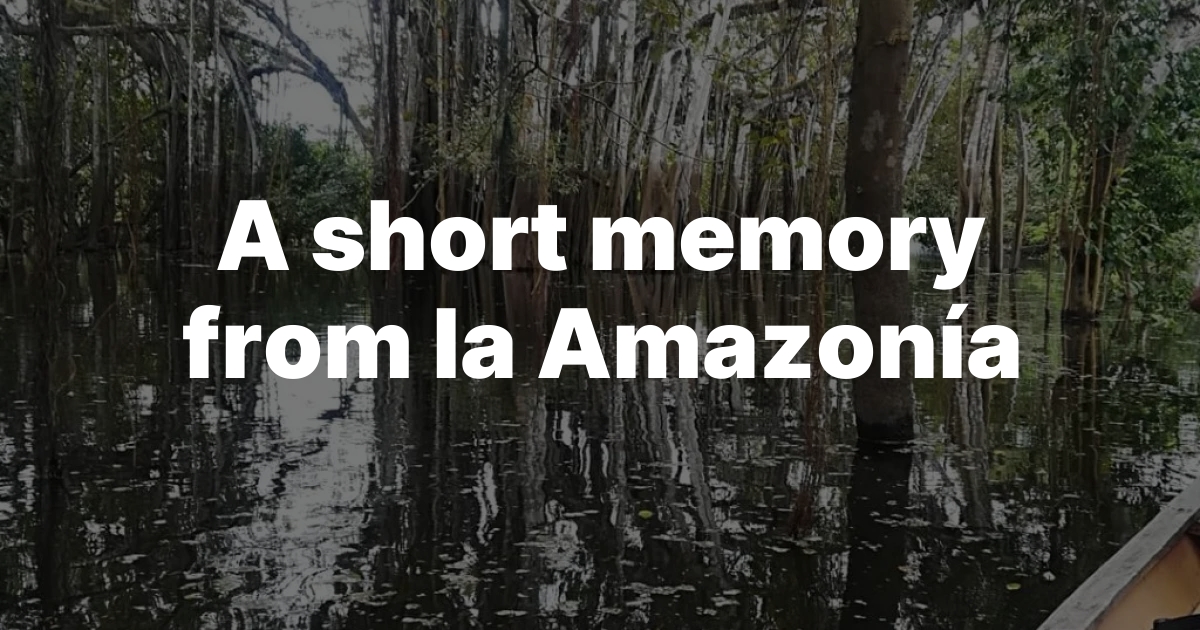
Nobody had warned me that howler monkeys don’t really howl. I hadn’t been expecting them to permeate the jungle with the calls of angry ghouls. I didn’t know that their rumbling gregorian chants would travel miles through the walking palms and ungurahui trees of the rainforest.
“Is it your first time here?” He twisted his head back from in front of me, gracefully moving through the cracking twigs and dangerous looking shrubs as though he were a part of the forest floor.
He had sensed my startle at the far off noises. I think he was trying to comfort me.
“In the Amazon? Yes. In Colombia? no” I responded in broken Spanish. I’d been practising since I arrived on this continent eight months ago, in late 2017.
I clumsily moved through the trail, swatting mosquitos off my face. Hopping from one paving stone to the next, following my guide. Paying extra careful attention as not to brush up against any unknown leaves or toxic creatures.
Gazing out over to a mud puddle I remembered a television show I watched years ago, where someone managed to survive a night lost in this jungle by hiding in the mud. That it was a miracle, in this hot and humid rainforest teeming with anacondas and tarantulas, that an unprepared human might make it through the night alone. Despite my own jungle hiking experiences, I still doubted I would succeed in such a miraculous survival story here.
After some more silent walking, I added – “It’s always been my dream, I mean – this. To come here” I fumbled around to find the right words “it’s my birthday”
Hop, hop, hop. The paving stones were unevenly placed and some sinking into the wet earth. I hopscotched between them like an excited small child. It was flooding season, and everything was a bit squishy underfoot. I stumbled along under the weight of my backpack, stuffed full of mosquito repellant and a bottle of celebratory bubbly wine.
“Happy birthday!” He grinned back at me broadly, not missing a beat on his well worn path. “We will be at your treehouse in just another 10 minutes, it’s just up ahead” He gestured out in front of him with his walking pole.
“we have a few rules. Before each meal a guide will come to your treehouse to walk with you. You shouldn’t walk alone out here, especially at night. It’s much too dangerous.” He paused a moment, waiting for me to absorb the seriousness of the situation and respond with a solemn nod of understanding. “Then” he announced, “Once you’re finished eating, we will walk you back to your treehouse again”
I had dreamed all my life of coming here, and this was not my first far flung adventure. It felt like I’d prepared my whole life for this moment, and I was giddy with excitement.
Up ahead stood in the forest enormous poles, leading up to traditional Amazonian treehouses. We eventually reached the base, and made the ascent up into my new lodging.
Once my guide had left, I sat swaddled in mosquito nets and opened my birthday bottle of wine – at once realising I hadn’t bought anything to drink it from. I sat for a moment, contented and sweaty. The heaviness of the jungle humidity caught up to me as I glugged sparkling wine out of the bottle. I admired a family of bats roosting in the eaves of my home, and I listened to the roaring furore of howler monkeys in the distance. Thirty two is going to be a good year, I thought to myself.
I was washing dishes last night, tuning out the day to a podcast while I scrubbed and loaded up the dishwasher. Joe Hudson’s voice through my headphones as part of my Connection Course homework. He was talking about wonder, not as some abstract concept, but as a way of being that I’ve carried my whole life without ever really examining it.
“Wonder is like curiosity without looking for an answer,” he said. “When you’re looking for an answer, you can just feel in your system that your system constricts a little bit. But if you’re just like, ‘Oh my gosh, what is happening here?’ and there’s no pressure to find an answer… the physical state remains expansive.“
This was something I knew intimately but had never called out or thought about specifically.
I’ve always admired children’s sense of wonder, and ever since becoming a mother, I’ve wanted to be someone who engages Emily’s sense of wonder rather than getting frustrated when she asks endless “whys.” I love to understand things, ask questions about everything (I think this is my natural curiosity and wonder coming through).
Wonder doesn’t require an answer. You can just wonder about what something is or why or how, without needing the answer. In our Google-driven world, answers are easy to find. The wondering itself is what matters.
Joe also talked about how wonder with a motive can feel creepy, and that got me thinking about something I’d never connected before. Sometimes when people ask me lots of questions, it feels exciting, like they genuinely want to know me. But other times, the exact same behaviour feels invasive or prodding. The difference, I realised, isn’t in the questions themselves but in the quality of curiosity behind them.
Authentic wonder is like genuine enthusiasm in presentations. It comes across as real because it is real. Someone giving a presentation about something they don’t care about has a lot of parallels to somebody asking questions when they’re not actually in wonder, but instead have a goal they’re trying to reach. This connects to something I wrote about before, the infectious enthusiasm of those chocolate frog professors who genuinely care about their subject matter. If you’re really in wonder, that comes across as genuine. It’s the difference between curiosity that seeks connection and questioning that serves an agenda.
I know exactly where wonder lives most naturally in my life. When I watch Emily discover the world, the way she stops to examine every interesting rock, how her eyes light up when she spots a magpie in the garden, I’m reminded of what unguarded curiosity looks like. She doesn’t need answers to everything. She’s content to point and marvel.
The garden brings the same quality. Spending time with plants, whether it’s planning companion plantings or just watching the way morning light hits the leaves, it’s impossible not to feel wonder at the natural world. There’s no performance pressure there. Emily doesn’t need me to be an expert on entomology when I point out an interesting insect. The plants don’t evaluate my credentials, they just respond to attention and care.
These spaces feel safe for wondering because they’re genuinely reciprocal relationships. I learn from Emily as much as I share with her. The garden teaches me as much as I tend to it.
But something different happens when I try to bring that same wonder into my technical work. I start out beautifully. New technology, workflows, and tools light me up. I get really into thinking about how they could be used, what they’re similar to or different from, how they might work in unexpected ways. That’s pure wonder in action.
But then I almost always shift quickly from wonder into answer-finding mode. And then, here’s the strange part, I stall when it comes to sharing my discoveries with others.
I think there’s a perfect storm happening here. First, perfectionism kicks in: “This insight isn’t complete enough yet.” Then imposter syndrome: “Who am I to share this discovery?” Then the cultural programming I grew up with, that tall poppy syndrome reminder not to stand out or claim too much expertise.
The AI field makes this worse. There’s pressure to constantly consume and adopt, to have hot takes on every new framework, to keep up with a pace that’s frankly exhausting. It’s like trying to observe fireflies while someone keeps shining a flashlight and demanding I categorise each species immediately.
Sometimes I feel frustrated at how quickly the industry moves. It requires too much constant adoption to pause and be in genuine exploration. The wonder gets squeezed out by urgency.
If I’m honest, some of this pressure is self-imposed. My ADHD brain wants to chase every shiny new development in AI. I find myself trying to follow the industry’s pace rather than my natural exploration rhythm, the same rhythm that creates my best insights when I give it space.
What if the real constraint isn’t time for wondering, but permission to wonder at my own pace? What if instead of trying to blog about every new AI development, I could be the one who finds unexpected connections by sitting with fewer things longer?
But then reality hits. I’m giving two presentations on MCP architecture in eight weeks. I can’t slow down, I need to move forward with it. The timeline is set, and I need to deepen my expertise quickly enough to deliver credible talks.
Here’s where something shifted for me. What if this deadline could actually work with my wonder patterns rather than against them?
Instead of “I must become even more of an expert, fast enough not to embarrass myself,” what if it becomes “I get to explore this fascinating technology deeply and share what I discover along the way”? The same intensive timeline, but reframed as an exploration opportunity rather than a performance demand.
The presentations become a vehicle for sharing my exploration rather than a test of my expertise. Audiences connect more with someone sharing their genuine curiosity than someone trying to prove they know everything. And honestly, approaching it with wonder rather than expertise anxiety will probably make for much better presentations anyway.
There’s something Joe said in the podcast that keeps coming back to me. He talked about being “in the question” for ten years, not trying to answer it, but living in it. “What am I?” was his question, and every answer he came up with was just based on some context. The power wasn’t in finding the answer; it was in being in the question.
I think about this when I’m in the garden with Emily, watching her examine a snail shell. She’s not trying to solve the mystery of the snail. She’s content to exist in the wondering with it. There’s something to learn from that, about allowing curiosity to be enough, about not rushing to conclusions or solutions.
Maybe living in wonderment isn’t about having more time for pure exploration. Maybe it’s about bringing that garden-quality attention to whatever constraints I’m already working within. Even with presentation deadlines and industry pressures, I can choose curiosity over performance anxiety.
The real practice isn’t carving out separate time for wondering, but protecting that quality of attention wherever it wants to emerge. Following the trail of genuine fascination rather than the urgency of trending topics. Letting myself be genuinely curious about MCP architecture because it’s interesting, not because I need to position myself as an expert.
In the end, wonder might be less about changing what I do and more about remembering why I started doing it in the first place. That spark of “I wonder how this works?” that drew me to coding, to AI, to building things that didn’t exist before.
Emily points at butterflies not because she needs to catalogue them, but because they’re beautiful and surprising. The garden grows not because I’ve mastered botany, but because I pay attention to what each plant needs.
Maybe that’s enough. Maybe wonder isn’t something to optimise or systematise, but something to protect and follow wherever it leads, even if that happens to be toward a conference stage, sharing discoveries that are still unfolding.
Tomorrow I start Joe Hudson’s Connection course. This week, I’ve started reading Anne-Laure Le Cunff’s Tiny Experiments. Each evening, I’m working with apps to sharpen my algorithmic thinking. Somehow these three seemingly separate things feel deeply connected – the science of small experiments, the art of human connection, the systematic way of approaching the world with curiosity.
All mindset stuff, really. How to approach the world with wonder and curiosity.
This got me thinking about a conversation I had recently with someone who’d just graduated high school. They wanted to become a developer but were struggling with the maths in their computer science degree. “I’m just not a maths person,” they said, with that familiar resignation I recognised in myself not so long ago.
But what I’ve come to realise is that the maths isn’t separate from the thinking. It’s all one integrated way of approaching problems with curiosity and systematic experimentation.
I used to think I was no good at maths. There’s this huge global preconception that maths is hard, or worse, boring. I also used to think all the sciences had their own containers and domains. Engineering over here, computer science over there, biology somewhere else entirely.
But algorithms are everywhere.
When you’re developing a bread recipe, testing different hydration levels and fermentation times, noting which combinations create the perfect crumb – that’s scientific method. That’s data collection. That’s algorithmic thinking. Cooking, especially baking, is all about chemistry, but we don’t typically call bakers chemists.
When you’re planning which plants to grow together in your garden, observing which companions thrive and which compete, adjusting based on soil conditions and seasonal patterns – that’s A/B testing. That’s experimental design. That’s pattern recognition.
I’m currently really enjoying Algorithms to Live By, and there’s this bit about apartment hunting. The book explains that harried renters need the 37% rule: spend 37% of your search time exploring options without committing, then immediately commit to the first place that beats whatever you’ve already seen. It’s not just intuitive compromise between looking and leaping – it’s the provably optimal solution to what computer scientists call “optimal stopping” problems.
Once I started looking, I could see it everywhere. The explore/exploit trade-off that helps me balance trying new things with enjoying my favourites. Sorting theory for organising my desk. Caching theory for arranging my wardrobe. Scheduling theory for managing my time. Brian Griffiths makes some excellent points, algorithms really are everywhere.
This made me wonder about engineering as a science. I’ve always thought of it as one, but why is it a whole separate department at universities? Why do we compartmentalise education into these distinct subjects when the underlying thinking is all connected?
Some European school systems already get this. The Danish system integrates various aspects of science across different subjects rather than separating them into distinct disciplines. Programs like Cambridge IGCSE offer Combined Science qualifications where students study biology, chemistry, and physics as one interconnected course. At the university level, interdisciplinary Bachelor’s programs provide broad education that integrates multiple core scientific disciplines.
There’s an urge to recombine, to see the patterns.
Following scientific method – even loosely, even personally – leads to better understanding of everything. Using analytics and data to drive decisions creates better products, tools, more efficient use of time. When we debug code, we’re hypothesising about what might be wrong, testing our theories, collecting evidence. When we iterate on user interfaces, we’re running experiments and measuring outcomes.
It’s all the same thing in different forms.
Everything is connected, and once your mind starts thinking in this way, it’s the same underlying pattern recognition showing up across every domain. The wonder of discovering how interconnected everything really is has changed how I approach technical problems, as well as how I mentor others.
When someone tells me they’re “not a maths person,” I can say with confidence: “Actually, you might already have these thinking skills – let me show you where.” Because they’re probably already experimenting in their kitchen, optimising their commute, troubleshooting why their plants aren’t thriving, finding patterns in their work that help them make better decisions.
That’s scientific thinking. That’s algorithmic reasoning. That’s the same cognitive toolkit that powers everything from machine learning to sourdough starters.
So here’s what I’m wondering.. what other “separate” skills are actually expressions of this same underlying pattern recognition? Where are we all already collecting data and running experiments in our daily life without realising it?
Maybe it’s time we stopped teaching subjects in isolation and started teaching the thinking that connects them all – the curiosity, the systematic experimentation, the willingness to test assumptions and adjust based on evidence.
Because the truth is, we’re all scientists. We’re all running tiny experiments, all the time. We just don’t always recognise the algorithm behind the wonder.
I remember nothing from that biology class at Otago University eighteen years ago – not the curriculum, not my classmates, not even what grade I got. But I remember his frogs.
There was this professor who would hand out chocolate frogs when we answered bonus questions correctly. He’d share a frog fact of the day during breaks, and his face would light up talking about the incredible healing compounds found in various frog venoms and skin secretions. The potential locked away in these tiny creatures to cure human diseases, to solve problems we hadn’t even discovered yet.
I was 21, studying Health Sciences, and I remember being absolutely captivated – not by biology particularly, but by how much he cared about frogs. His enthusiasm was infectious, ringing out through one of those big old 1970s Archway lecture theatres. Students would lean forward despite themselves when he started talking about his research trips to South America, and into the Amazon rainforest.
Recently, I was preparing for an upcoming speaking engagement, feeling nervous about how to share technical concepts effectively. Someone recommended I watch Damian Conway’s talk on instantly better presentations. I clicked play, coffee in hand, hoping for some practical tips.
“Seeing someone excited, is exciting.”
He went on to talk about David Attenborough being the best technical presenter in the world (in his opinion) – not because of perfect delivery or comprehensive knowledge, but because you can see his passion for the natural world in everything he does, everything he says. He really, really cares.
And suddenly, I was back in that lecture hall at Otago University. That professor whose name I couldn’t even remember.
Watching Damian’s video, I realised what had made that class so memorable wasn’t the subject matter at all – it was witnessing someone who genuinely, deeply loved what they were sharing.
This reminded me of an instructor training course I took many years ago now. I had to deliver a short talk on anything, so I chose neuroscience and talked about alien hand syndrome – this fascinating condition where one hand acts independently of conscious control. I thought it was so incredibly interesting, and had recently been absorbed into The Man Who Mistook His Wife for a Hat and Other Clinical Tales. People in my class told me for years afterward how much they’d enjoyed that presentation.
There was something about the intersection of complex technical topics and authentic enthusiasm that kept showing up in my life. And as someone with ADHD who struggles to work on or focus on things I don’t find genuinely interesting, I’d been seeing this need as a constraint I had to work around.
But I began to see it differently – as a superpower I should be leaning into more intentionally.
Curious about that long-ago frog professor, I did some research. His name was Phil Bishop – Professor Phil Bishop from the Department of Zoology at the University of Otago.
Phil began his frog fascination very young and devoted over 30 years of his career to studying them in depth. He made amazing discoveries – including that New Zealand frogs communicate chemically – and authored over 80 scientific papers. He was integral to the native frog recovery plan, a compelling communicator who earned national recognition for his teaching and outreach.
And here I am, eighteen years later, still carrying something he planted in that lecture hall. Not facts about amphibians, but something much more valuable – the understanding that genuine passion is what makes knowledge come alive.
When Damian Conway praised David Attenborough, he was describing exactly what Professor Bishop had: that rare ability to make others care about something through the sheer force of your own caring. Whether it’s frogs or the natural world or frontend development tools – you have to find a way to be excited, moved, enthralled by what you’re sharing.
I think about other speakers and writers I admire most deeply, and the pattern holds. It’s never about perfect delivery or comprehensive expertise. It’s about authentic enthusiasm for ideas that matter to them.
As I prepare for an upcoming speaking engagement, I’m no longer thinking about becoming an expert in something new or delivering dry technical content. Instead, I’m thinking about sharing what genuinely excites me most. I’m thinking about how to tell that story with the same infectious care that made chocolate frogs memorable in a lecture hall two decades ago.
Professor Bishop taught me something I didn’t realise I was learning: that genuine passion isn’t something to manage or work around, but the very thing that makes technical communication powerful and lasting. He probably never knew that his chocolate frogs would still be working their magic eighteen years later, inspiring someone in a completely different industry to approach technical presentations differently.
A storm, a lightning strike, an earthquake, and a dying father’s prophecy (yes, really!). This is the story of how grief, adventure, and a bit of fate carried me from a nomadic life to a role at Automattic, where I’ve spent almost eight years helping build and contribute to WordPress (and WordPress.com, Jetpack, WooCommerce and other Automattic products). Now, as Automattic celebrates its 20th birthday, I’ve been reflecting on that wild, beautiful path; and how it all somehow led me exactly where I was meant to be.
I’m a little late to the party writing this reflection on Automattic’s 20th anniversary. Not because I forgot, or because I don’t care, but because I’ve been sitting with how to piece together a story that feels both impossible and inevitable at the same time.
Almost eight years ago now, I was standing soaked to the bone in a hotel room in Oaxaca, Mexico, hanging wet clothes everywhere after lightning had literally struck in front of us during a massive storm. Hours later, an 8+ magnitude earthquake would shake the city. The next morning, I’d stuff my suitcase with damp, gross laundry and board the first of two overnight flights to Whistler, Canada, to start a job I was still convinced was too good to be true.
But let me back up.
The Prophecy
My father was a computing lecturer who did some contract software development on the side. He was the kind of dad who taught his daughter QBasic in the early 90s, when most kids didn’t even have home computers, let alone girls learning to code. We did logic puzzles together. He loaned me programming books as I grew up. We talked about code the way other families talked about sports.
I learned PHP in my teens and had hobby projects scattered everywhere, including local bbPress installs and eventually WordPress once it became a thing. (Fun fact: WordPress’s birthday, May 27th, is also my birthday – just a different year. Some signs are more obvious than others.)
But life took me in different directions. I became a chef, tried medical school, worked as a bartender, became a flight attendant. For years, I nomaded around the world, freelancing – writing, attempting graphic design (definitely not my thing!), building WordPress sites, and fixing WordPress problems. My dad had always thought I’d come back to computing eventually.
During the early days of those nomadic years, my father got cancer. I thought we had five years together, so I returned to New Zealand to spend whatever time he had left with him. Dad connected me with people who needed WordPress consulting work – fixing plugins, designing custom themes, the whole spectrum. He was building a bridge for me back to the world he’d always believed I belonged in.
Dad didn’t live five years. He didn’t even live two months past when I got back. Devastating for me.
Near the end, I told him maybe I should settle down and get a proper job. “How about a travel agent?” I suggested. “I’ve seen the world, my geography is excellent, I was a flight attendant – I know airports and airlines.”
He looked at me and said no, I would be so bored in an office. I would hate it. Don’t give up, he told me. He thought my future was WordPress. Not development, not computers, not even PHP specifically. WordPress. He didn’t know why, but he had a feeling.
The Journey
After Dad died, I had enough inheritance not to work for a while. Once we sorted his affairs, I set off across Asia by train – honoring his two greatest passions: trains and Asian travel. I started in Singapore and wound through Malaysia, Thailand, China, and Mongolia, then flew to Albania and traveled up through the Balkans to France. I blogged about the journey. Sometimes I wondered what I might do next, but there was no pressure. The money was holding out, and I was processing grief in motion.
Then, in some Facebook freelancers group, a job posting appeared.
It wasn’t just any job. It was THE WordPress job. At Automattic. The company behind WordPress.com, the very platform that had been part of my life for years. And the requirements? Customer support, but technical. People person, but code. WordPress experience. Remote work welcome.
It felt like a message from Dad.
The Impossible Interview
I applied, terrified and convinced it was too good to be true. Imposter syndrome was screaming in my ears, but in hindsight, I was such a perfect fit.
The entire interview process was conducted via text – no voice or video calls. I was impressed by this intentional approach to avoid bias based on how someone looks or speaks. Then came the trial: a month-long process that started with over 50 people and worked like Survivor, with eliminations each week until around 20 of us got hired.
The Grand Entrance
In 2017, Automattic’s Grand Meetup was in Whistler, Canada. It also happened to be my first day of work. And it came exactly one week after I had moved to Mexico.
The timing was absurd. I’d been in Oaxaca City less than a week. At Cancun airport, I’d gotten scammed by the taxi mafia (that’s a whole other blog post). I frantically searched for a six-month rental while staying in a hotel, finally found the perfect place, and signed the lease. As I left the apartment, that massive storm broke. Lightning struck directly in front of me. Water rushed rapids down the roads waist-high. I reached the hotel completely soaked.
That night: the earthquake. Coming from Christchurch, which had its own devastating earthquake, I had serious PTSD. The ground shaking in a foreign country, in a job that still felt like a dream, pushed every anxiety button I had.
The next morning, I stuffed wet laundry into my suitcase and began the long journey to Canada to start a job I was still half-convinced was fake.
All new hires had to give a flash talk at the Grand Meetup. I wrote mine on the plane, about the incredible journey that had brought me there – including the overland Asia trip after Dad’s death, the inheritance that gave me freedom, the Facebook post that felt like destiny. It’s been almost eight years since that day, and I can still feel the electricity of that moment.
In fact, with a little light digging, I was even able to find the recording of that very talk:
The Work
I started as a WordPress.com Happiness Engineer, which sounds like typical customer support but is so much more. It’s technical support with real responsibility – working in GitHub, debugging, writing CSS and JavaScript. In 2021, I transitioned to Code Wrangler, where I’ve been ever since.
The nomadic lifestyle continued for years. I worked from a jungle house in Costa Rica, poolside in Nicaragua, all over Mexico from coast to coast and mountains in between, Portugal, back home in New Zealand during COVID. Forty-two countries in total, many of them while at Automattic.
Since meeting my Mexican partner and having a baby born in Mexico, we’ve settled in Australia where I bought a house and work from my home office. But those years of nomading while building code that powers WordPress sites around the world? That was living the dream in ways I couldn’t have imagined.
The Circle
Now I contribute directly to the ecosystem of a product that has been important to me for so long. When I attend events and tell people I work for Automattic, that I write code that helps power WordPress, I feel a pride that connects back to those early days learning QBasic with my dad.
He would be so proud. I’m absolutely sure of it.
There’s something beautiful about working for a company that believes in the democratisation of publishing, in giving everyone a voice on the web. Dad believed in me when not many girls were learning to code. Automattic believes in potential in all its forms – remote workers, nomads, people with unconventional paths.
Twenty Years
Happy 20th birthday to Automattic. Thank you for building something that honors the web as a place where everyone belongs. Thank you for taking a chance on a nomadic WordPress consultant who saw a job posting that felt like a message from beyond. Thank you for almost eight years of growth, adventure, challenge, and the deep satisfaction of contributing to something bigger than myself.
And Dad? You were right. My future was WordPress. I just had to trust the signs along the way.
I originally wrote this three years ago on the anniversary of my father’s 67th birthday. Today would be his 70th, so I’ve decided now is a fine time to move it off facebook and onto my blog instead. So, here we go:
It feels stilted and uncomfortable to try and celebrate the fact you were born, when I’m still grappling with the idea that you ever left
I’ve thought through the morning how to rustle through the grief for a thread of celebration, to put aside the two missed birthdays behind us and instead focus on the time that you were here before that. Focusing on the idea that celebrating somebodies life and birth need not require their presence.
For your birthday I cannot get you gifts or take you for dinner, even though I have since discovered surely no less than five thousand new places I think you’d love to go.
We can’t go away together on a trip, and you have no pockets to hold your passport.
I can’t cook for you any longer, but I can spend my life scouring the tiny corners of the planet for the kinds of foods you would love to try.
I can only bring you with me in memory for the railway journeys and street food excursions, the adventures in mistranslation and the most bizarre of travel stories I know that you, and only you, would appreciate. I can carry you with me in my thoughts, and more importantly through my words and in my stories, and for that experience I am grateful.
I think you’d be happy this year. Happy for our annual birthday check-in – where we talk about our lives and our goals, where we’ve been and where we are going in this crazy life. I’d get to tell you all about the life I’m living, you’d listen with great interest as I told you about how I finally visited the Amazon. You’d immediately ask if I saw any Anacondas, and tell me some hilariously inappropriate story about lost adventurers being eaten alive, knowing full well it would do nothing but fuel my sense of adventure.
We’d talk about my job, and how incredible it is that everything you taught me, all you encouraged me in from the moment I could use a keyboard had brought me to where I am. I’m living my dreams, I’d say. I have a great life and a wonderful job, I make good choices in my life and relationships and I know how to stand on my own two feet.
You’d be so proud.
What are you reading today? you’d ask.. scoping me out for new book recommendations as you made a large handful of your own. Exchanging books became a bit of a birthday tradition, didn’t it? I’ve read so many of your books since we last spoke. I’ve kept them all and as I make my way through page-by-page I take tiny pieces of you from every character I meet. I don’t keep things, I don’t own stuff, but I kept every single one of your books.
If it were your birthday today, in person and for real, I would be looking forward to hearing about the latest addition to your miniature railroad. That land that exists as a magical other world spilling out from your spare bedroom. I’d await eagerly the latest news of the tiny locomotive making its way in a missing package from Germany, we’d joke about the world tour it was taking as we spied on the tracking number in anticipation of its arrival. Prodding you to let it expand and take over your house, tiny tracks making trails across all the walls and out into the world.
But instead, you’re not here.
And for your birthday I’m left with a million happy memories and a series of questions. Where will I next find your memory? I find you in the strangest of places – I find you in the comforting clack-clacking of late night rail journeys, and I meet you again in every geranium, I remember you in anteaters and in thistles, Thai food and mistranslated English signs. I find you in Bill Bryson, Paul Theroux, Paulo Coelho. I find you when I finally discover where the missing semicolon was hiding amongst ten thousand lines of code and I laugh, I laugh out of frustration and relief and because I remember how it would make you laugh just the same.
I find you when I look at the person I’ve become, the jokes that I find funny and the ways I’ve grown to see the world. It’s in all these places that I find you that I get to celebrate your birthday. Happy birthday. Thank you for never quite leaving me, and for all the places you turn up.
Two years ago today my father died. I hope today by focusing my thoughts away from grief and loss and instead into sharing gratitude and love with the world around me I can shine some happiness into an otherwise difficult day I’m grateful for … inheriting your sense of adventure and braveness for visiting places for their culture and people, not tourist sites for encouraging me always to pursue what I’m interested in passionate about and not letting me settle for less than that for being my source of unwavering rational advice and practical solutions, peacekeeper and careers advisor.. over and over and over again for having me, rent free in your home all the times I chose paths of volunteering, or when I was simply just lost in life for a brief moment fish and chip Fridays your amazing model trainsets your wonderful sense of humour for keeping your shelves always stocked with new books for me to devour for a childhood worth of weekend swimming pool & hydroslide adventures for introducing me to Thai food and my first ever green curry sparking a lifelong obsession for all the quiet nights in watching trivia gameshows on the tv with you for always telling me how proud you were, even when the choices I made probably terrified you for teaching me how to use a computer from when I was about as small as the picture here, and not much later on teaching me how to code .. skills that have led to where I am today for every time you got up at 5am to drive me to an ambulance shift when I was a grown adult and probably should’ve worked it out for myself for bailing me out of so many things, so many times For always sharing my writing and telling anyone who’d listen about me and my work for introducing me to the wider world through stories, books and conversations for the endless hours spent in logic puzzle books with you for taking a morning out of each and every day to go out for coffee with me before work in the weeks before your cancer properly took hold For telling me in those last few days to keep traveling, keep pursuing my dreams, keep focusing on this life I’ve built once you’re gone
At the beginning of 2021, I set myself a goal to read 50 books. I almost slid just in there, although I didn’t quite finish book number 50 before the end of the 31st! So whether I completed the challenge or not is up to intepretation, but I think it’s close enough to count.
It will come as no surprise when I say that 2021 was an unusual year. In pre-pandemic times I would read a lot of difficult books, memoirs non-fiction, and literary fiction. But I’ve noticed over the past two years, since the world got a little more complicated, most of my books have been beach reads, romance, and escapism. It’s been a nice shift, and I’ve enjoyed stepping outside of my usual genres and getting lost in some light and fluffy love stories.
Highlights from 2021: Piranesi (favourite fiction), Molecules of Emotion (favourite non fiction), One Last Stop (favourite romance), and Eat Pray Love (favourite re-read)
Moleculesof Emotion by Candace B. Pert
The Biology of Belief by Bruce H. Lipton
The Spanish Love Deception by Elena Armas
The Power of Now by Eckhart Tolle
Until Next Weekend by Rachel Marks
Saturdays at Noon by Rachel
The Spark by Jules Wake
The Road Trip by Beth O’Leary
Sunrise by the Sea by Jenny Colgan
Beach Read by Emily Henry
While We Were Dating by Jasmine Guillory
SEX/LIFE by B.B. Easton
I Owe You One by Sophie Kinsella
Dumplin’ by Julie Murphy
Love Your Life by Sophie Kinsella
The Regulars by Georgia Clark
Fiber Fueled by Will Bulsiewicz
The Bucket List by Georgia Clark
It Had to Be You by Georgia Clark
I’ve Got Your Number by Sophie Kinsella
Can You Keep a Secret? by Sophie Kinsella
Remember Me? by Sophie Kinsella
Life’s A Beach by Portia MacIntosh
The Undomestic Goddess by Sophie Kinsella
One Last Stop by Casey McQuiston
My Great Ex-Scape by Portia MacIntosh
The Time of Our Lives by Portia MacIntosh
My Not So Perfect Life by Sophie Kinsella
Wedding Night by Sophie Kinsella
Stuck On You by Portia MacIntosh
Grown Ups by Marian Keyes
Paris is Always a Good Idea by Jenn McKinlay
Dreaming of Verona by T.A. Williams
Recipe for Persuasion by Sonali Dev
Piranesi by Susanna Clarke
Sofia Khan is Not Obliged by Ayisha Malik
The Dating Charade by Melissa Ferguson
Eat, Pray, Love by Elizabeth Gilbert
Anybody Out There? by Marian Keyes
The Mystery of Mercy Close by Marian Keyes
How to Make a French Family by Samantha Verant
Angels by Marian Keyes
The Woman Who Stole My Life by Marian Keyes
Watermelon by Marian Keyes
Lucy Sullivan Is Getting Married by Marian Keyes
Rachel’s Holiday by Marian Keyes
Gone Viking by Helen Russell
Happiness for Beginners by Katherine Center
You and Me on Vacation by Emily Henry
Save Me the Plums: My Gourmet Memoir by Ruth Reichl
In 2018, I decided to give living in one place a try. Through a few last minute change of plans, and my brother already being there, that place ended up being Melbourne, Australia.
As it turns out, I wasn’t ready to stop travelling, and my year in Melbourne was cut short, as I took off bound for the Oaxacan coastlines of Mexico. But the city of Melbourne will always hold a special place in my heart, and it’s a city I feel has so much to offer, and much for me to go back and explore again, and again, and again.
Here’s a quick love-note-list of reasons I love Melbourne ??
Flat Whites
If you’re from Australia or New Zealand, you will already be well familiar with the distinctly antipodean version of coffee – the humble flat white. And, truth be told, if I had been arriving in Melbourne from my home country of New Zealand, this wouldn’t have excited me in the same way.
But, I had not been to New Zealand in a while, and had spent years travelling around Asia and Europe, far from my beloved coffee, and arriving back somewhere that makes these so well was super exciting. I was delighted.
A flat white is like a latte, but with more milk. It’s kind of difficult to describe, but trust me, it’s better.
If you’ve never tried one (or you’ve only tried them outside of NZ and Aus, which doesn’t count) Melbourne is an excellent place to start. It’s practically a sin to butcher a flat white here, so you can get an excellent drink just about anywhere you try.
Long Summer Evenings
Melbourne puts on a stunner of a summers evening, with temperatures (and sunlight) soaring until the late hours. At the peak of summer, it can be hot and sunny until almost 9pm, and gorgeous average highs hovering around 28 Celcius (and soaring up into the 40s from time to time!)
The months I lived in Melbourne were all summer months, so my opinion is a bit bias! Previous trips into the city throughout other times of the year have proven Melbourne is not immune from gross winter weather, either. But the summer evenings are just so lovely it makes up for it.
Yarraville
Yarraville is an inner suburb to the West of the city centre, and it’s pretty fabulous – not just because it’s where I found my apartment and based myself (also that!), but because it is full of trendy cafes, leafy parks, and is off the well-trodden tourist trail of the city – whilst still being only a couple of quick train stops from the heart of very Central Melbourne.
It’s a beautiful neighbourhood to wander about on a sunny day, and has a strong sense of community for such a small, central neighbourhood. And for its size, the variety of excellent restaurants and cafes is impressive. The art deco Sun Theatre is a great spot to watch a film in a gorgeous, traditionally restored & maintained 1930’s theatre, and one of my favourite brunch spots in all of Melbourne is here: Dad and Dave’s Cafe
Love craft beer? Melbourne’s got you covered. I did not, in fact, love craft beers. At best, I liked them from time to time. But Melbourne changed that for me, and introduced me to a whole new world of delicious drinks. There’s no shortage of trendy craft breweries to discover, and maybe if you’re like me your whole attitude towards beer might shift!
But that’s not even the best part of the Melbourne beer scene, nope – the coolest part is just how many rooftop bars there are tucked away in the city. So many unsuspecting doorways leading up narrow stairs to super cool rooftop bars with awesome views. They are honest just about everywhere, and I continued to be surprised
Melbourne Street Art
Melbourne City Street Art, photo by Anna McPhee
The Melbourne Train Stations
I grew up in a city without trains, so funky train stations and railway travel through the heart of a city will always be a novelty for me. But some of the train stations in Melbourne are simply charming.
My favourites were the Yarraville station, for something that felt like stepping back in time to a tiny little rural station (yet mere stops from the heart of downtown) and Flinders Street Station for being so gorgeous and magnificent, in exactly the opposite way from Yarraville!
The Greek Precinct
Many people don’t realise that Melbourne is the city with the largest Greek population, outside of Greece. In fact, I hadn’t known this either until I read Afternoons in Ithaka. But it’s true!
Greece is a country I am rather enamoured with, and one that will always mean a lot to me. So it was wonderful to find that Melbourne city has a busting Greek precinct full of typical Greek restaurants, where I could catch up on all my favourite Greek foods and goods. They even have a website that provides more information about this little central city gem.
Melbourne has good food running through its veins, and it would be impossible to provide a list of the best cafes here because there are just so many (but here’s one of many lists, if you need one!) but safe to say, my inner foodie was in love. It’s an especially great place to go out and find brunch
Tram Life
Melbourne currently has the largest urban tram network operating in the world, which is pretty impressive. For me, getting around by tram feels like a rare public transport treasure and reminds me of some other very cool cities, such as San Fransisco and Lisbon. Exploring the many different tram stops (over 1700 of them!) is something I rather love about Melbourne.
Fitzroy
Fitzroy is another of my favourite Central Melbourne suburbs, a hub of trendy cafes, galleries and bookstores with a famously bohemian vibe. It’s also where you’ll find my favourite little perfumery, Lore Perfumery.
The majestic Yarra river flows through the heart of downtown Melbourne, and is an iconic feature of any cityscape snap. The beautiful river is important for locals, tourists, and even holds spiritual significance for Aboriginal communities. It’s a pleasure to wander the banks, and explore the city along the Yarra.