Every journey deserves to be remembered, and photography has become my way of capturing not just what places look like, but how they feel. From the golden light over Mongolian gers to the vibrant colors of Caribbean markets, these posts pair stories with the images that help me remember why travel moves me so deeply.
It was summer twenty sixteen, and in a desperate bid to lay low and recover from my time volunteering in Greece I was on a somewhat aimless wandering around the warmer parts of Europe. Sleeping in hostels, picking up volunteer work in exchange for a bed and a meal, writing for money when I could find it. Seville was my ultimate end-goal, and I had been inching my way closer through the spring, traveling through Bulgaria, Romania, Portugal, and finally on to Spain.
I’d dreamed of Seville for a long time. Romantic visions of flamenco guitarists emanating from the rooftops amidst the intoxicatingly perfume of orange blossom in the spring. I had fallen hopelessly head over heels for Spain on a brief visit to Madrid before entering Portugal earlier in the summer and I’d been itching to get back.
I narrowly missed my springtime daydreams and arrived Into the Andalusia region in early July.
I meandered through orange trees and brightly painted buildings exploring the barrios one by one. Basking in the sweltering late afternoon heat, getting feverish fantasies about fresh sangrias and thin slivers of jamón curled over crusty bread. The summertime sunshine was slow roasting me in new and unusual ways yet the pull to explore was overcoming all common sense.
It gets so hot in Seville in the depths of summer that the central district is covered in shade sails, and the outdoor restaurants are a haven of gentle water misters. In many cases all it takes is too many steps away from the airconditioning and your pulse starts racing with the heat and dehydration.
It was just coming up ten at night, and the temperature had dropped to a pleasing thirty degrees celsius; the evening light had a romantic hint of dusk. Hoards of swallows were beginning to dip, dice and swoop around cathedral spires.
Mothers were out walking babies in prams, and shops were beginning to shut up for the evening. It was hard to imagine how late into the night it was becoming, and for the first time in my life I understood the Spanish way of eating dinner this late in the evening.
By 10pm the previously empty plazas were heaving with crowds, enjoying the cooling air, and the world was fragranced with peppery earl grey tea from the citrus tree leaves. Flamenco guitar students were sitting out in the summer air practicing along the promenades and on the roof tops as I made my way towards one of many Flamenco bars in the city.
Seville is full of Flamenco theatres, there is no shortage to choose from. I opted for La Carbonería, an old coal warehouse on Calle Céspedes. Touted by some as a hidden gem, by others a tourist trap – whatever it was the experience felt authentic and magical. The power and energy of flamenco well beyond anything I’d imagined.
As all my daydreams of this magnificent city came to realisation, I was captivated. The sounds and emotion, the complex guitar, skirt flipping, stomping and guttural calls had me hooked. Flamenco was everything I’d hoped it would be, and then some.
The longer I had travelled, the more my desire for planning new destinations had fallen by the wayside. Not due to laziness, rather because at this time in my journey I’d come to deeply enjoy the last-minuteness of it all. A last minute trip to Bulgaria evolved into an even more last minute weekend in Bucharest, the capital city of Romania.
After a short shuttlebus ride exchanging stories with fellow foreign travellers of misunderstanding Bulgarian culture came to an end, we pulled into the heart of the city.
Bucharest is becoming a popular hub for remote workers; boasting some of the fastest internet speeds in the world, a host of gorgeous architecture, fascinating history and excellent cafe culture. This trip was the perfect excuse to get some work done and see the sights.
I hopped out of the van a little underwhelmed at the typical rural landscapes en route, said my goodbyes, and made my way off in an arbitrary direction. It didn’t matter which way I went as I had nowhere I needed to be. The bus from Ruse was easy, frequent and cheap; my severe lack of either language didn’t seem to hinder the process either.
A holiday arrival into Bucharest
It was Easter Sunday when I arrived. The shops sat closed and the streets empty. The sun was shining though and the few people about seemed to have a pretty good grasp of English. I spied things that normally send me running for cover: H&M, McDonalds, Starbucks. Instead I took a breath of relief from the familiarity of it all. A month in Bulgaria had taken its toll.
Bulgarian Leva weren’t going to get me far here, so I stopped in at the nearest bankomart. Right, how many Leu would I like, it asked nonchalantly. Good question, I wonder what a lei is worth? I stopped to ponder. I got out a hundred and stuffed them into my wallet. Would my wad of cash would pay for a weeks worth of hotels or a single coca cola?.
I took a leisurely jaunt down a wide tree-lined boulevard with patches of vivid purple irises where families basked in the shaded grassy knolls, and in the distance a giant fountain marked the entrance to Palatul Parlamentului, the second largest building in the world after the Pentagon. So impressively large, In fact, it can be spotted from space. With all the cafes shut for the day, I resigned myself to the steps outside of a store with free WIFI and browsed my phone for somewhere to sleep.
I made my way toward a cheap, nearby hostel, taking me past the river and some impressive historical buildings. The old city of Bucharest was marked by charming cobblestones and a narrowing of the walkways. A lone violinist belted out Vivaldi under the facade of a grand historical building.
Bucharest, AKA The ‘Other’ Paris
Known as the ‘little Paris’ of Eastern Europe, it doesn’t stretch the imagination too far to see why. It even has its own ‘Arcul de Triumf’. The old city is the pulsing heart with its uncovered ruins, cobbled walkways and stretches of restaurants that come alive in the night. Although not quite the same experience as Paris, it is a bucket load cheaper and affords many of the similar charms.
Other than that first day of glorious sun shine, the rest of my short visit in Bucharest rained. This was fine by me as I had a ton of work to get through. It was a great opportunity to explore Bucharest’s thriving digital nomad scene.
Working remotely from Bucharest
I spent a day working from Puravida hub; a co-working space, co-living space (in cahoots with the glorious Little Bucharest old town hostel next door) and tea house. Beautifully decorated with old speakers, retro posters and provence-esque tins of fragrant fresh lavender. I indulged in high-speed wifi to the ambient sounds of french jazz and looked out over the old city streets. Gazing down to the rounded copper roofs I spied the yellow umbrella of a lady walking in the rain. For a moment, this could easily be Paris.
Inspired by Romanian scenery
I only had four days to spend in Romania, but in my time there I learned of many other natural wonders in the country – spectacular mountains, picturesque villages, impressive castles (including Dracula’s castle!) and beautiful coastlines. Perhaps someday I will return to see what the rest of this unassumingly gorgeous, and often misunderstood, country has to offer. (Check out The Culture Trip’s ‘The 12 Most Beautiful Spots in Romania for some more inspiration!)
Where I slept, worked, and ate
Worked at: Pura Vida Hub, a delightful space, other co-workers and good Wifi, all for just 5euro for the day and nestled right in the heat of the old city. Perfection. If Pura Vida Hub isn’t to your tastes, Bucharest is a popular hotspot for digital nomads and remote workers so you’ll be spoiled for choice.. try out Seneca AntiCafe, ImpactHub, or TechHub, just for starters.
Slept at: The glorious Antique hostel. A leading competitor for both the more affordable, as well as the most relaxing shared hostels I have stayed at in all my travels.
Ate at:Dristor Kebap, just around the corner from Antique hostel. A mere 20-30 lei gets you an epic kebab plate loaded up with everything you could ever want (and things you probably hadn’t even thought of). Even cheaper if you’re happy to go gyros-style for a snack on the go. Arcade Cafe : Bucharest, well at least the old city, was a bit of a challenge to find breakfast, with most of the restaurants catering to the lunch and dinner crown. Arcade cafe was open each morning though, with good omelettes for 15-20lei and free wifi. Always busy and seems to be a popular choice for locals.
In the beginning there was no plan for any kind of Martinique road trip in this visit. Initially, we’d decided to go car-less for our three week stay in Martinique. The plan was to spend our time in the main city of Fort-de-France, living as much like locals as we could, using our time on foot explore what the town had to offer, and catch the occasional ferry or bus to see some other parts of the island.
After just a few days in Fort-de-France we quickly realised that a car is by far the best way to see Martinique, that the roads are some of the best in the Caribbean, and that car rental is simple and affordable (not to mention that driving a car seems to be what living like a local is all about, judging by the relentless traffic jams). This led to testing the waters with a day-long rental car and a quick search of what interesting stops lay toward the South end of the island.
Ferry to Pointe du Bout
To begin our Martinique road trip we had to pick up a rental car, choosing Europcar’s Trois Ilets Pointe Du Bout Car Rental in the town of Pointe du Bout, a short ferry ride away from the main Martinique pier. The Vedette Tropicales ferry from fort-de-france was an easy € 2.80 one way, and at the time of writing was running from 5.30 am to 7 pm during the week (with limited hours on Saturday and bad luck if you wanted to travel Sundays, much like other parts of France)
Picking up the rental car was straight forward, and quickly we were on our way, packed into the tiniest Renault Clio, the same car it appears all tourists are issued with upon renting a car in Martinique (or so we eventually decided after how many identical rental vehicles we encountered along the way)
Quick stop in L’Anse à l’Âne
After a scenic jaunt over the hill from pointe du bout we quickly realised that in all the excitement of boats and rental cars, we’d completely forgotten breakfast. Luckily, we were swooping down into the small beach town of L’Anse à l’Âne and in true French style, there was a roadside boulangerie (Pom’Kanel) selling breakfast breads and tiny paper cups of espresso. Somewhat revived after a quick stroll in the sand and a touch of caffeine, we decided not to stop any longer in this picturesque little town – we had another goal in mind, and that was the Robinson Crusoe beach of l’anse noire.
L’anse dufour and l’anse noire
Tracking around the Les Anses-d’Arlet peninsula for another 15-20 minutes leads you to the turnoff for L’anse dufour and l’anse noire. Two neighbouring bays – once deep volcanic black sand and the other pristine white sand, an impressive contrast and my two favourite beaches of our time in Martinique.
After driving through jungly hillside for a while, we happened upon a long string of matching white clios all parked down the roadside – a telltale sign of tourists and a hint we’d arrived at the right place. These beaches are only easy enough to reach with a vehicle, so they are much less crowded. However, they are my favourite beaches I encountered in Martinique and it was clear this day a handful of others felt the same.
Parking on the roadside we meandered down past blossoming bougainvillea and hummingbirds, looking out over the pristine white sand and coconut palms of l’anse dufour. A couple of beach cafes and guesthouses gave way to a small collection of sunbathing tourists and lapping, turquoise water.
Beautiful white sand & turquoise waters of Anse Dufour provide quite the contrast to the black sands of neighbouring Anse Noir
Continuing up the hill a little and down a large flight of concrete steps we came upon l’anse noir, the reason for this scenic detour. A long jetty protruded out from wild, dark sands. Large trees shaded much of the beach and tiny crabs skuttered about. A small shack rented kayaks and snorkeling masks by the hour, and offered to look after our bags while we swam.
If I come back to Martinique anytime soon, this is where I’d choose to park myself.
L’anse noir is one of the only spots where you can find sea turtles just about any day of the year, it’s simply a matter of renting a mask by the hour from the kayak and mask rental down on the beach. From there, swim out to the middle of the bay and voila – sea turtles.
Stunning black sand beaches of Anse Noir are the perfect stopover for swimming with some sea turtles
The Martinique Road Trip Continues: Down Le Diamant Coastline
After leaving l’anse noire with many promises to return someday, we hopped back into our tiny rental car and plowed on back up through the jungley hillside. From here we looped around les Anses-d’Arlet and spent some time cruising down the coastal roads of le Diamant, Sainte-Luce and Le Marin.
I had saved a number of eateries on my map along the way – Pizzbook for it’s island-famous pizzas, Hakuna Matata and Case Coco. Unfortunately due to it being a Monday afternoon, none of my choices were open – some due to the time, most due to it being a Monday. Such is life on a tiny French Island.
The roads became winder and less windy, and the beaches became more open with surf and less calm like where we’d arrived from. This whole road is lined with golden sand and crashing waves and coconut groves.
Sunset in Sainte-Anne
Sainte-Anne is considered by many the region with Martinique’s most beautiful beaches. We arrived to Plage des Salines in time to settle into the sand and catch a little of the late afternoon sunset before the sky was overtaken with the most beautiful sunsets. It has been the most wonderful road trip through magnificent Martinique, and we were rewarded with surreal views to end the day before finding our way back up to Fort-de-France for the night.
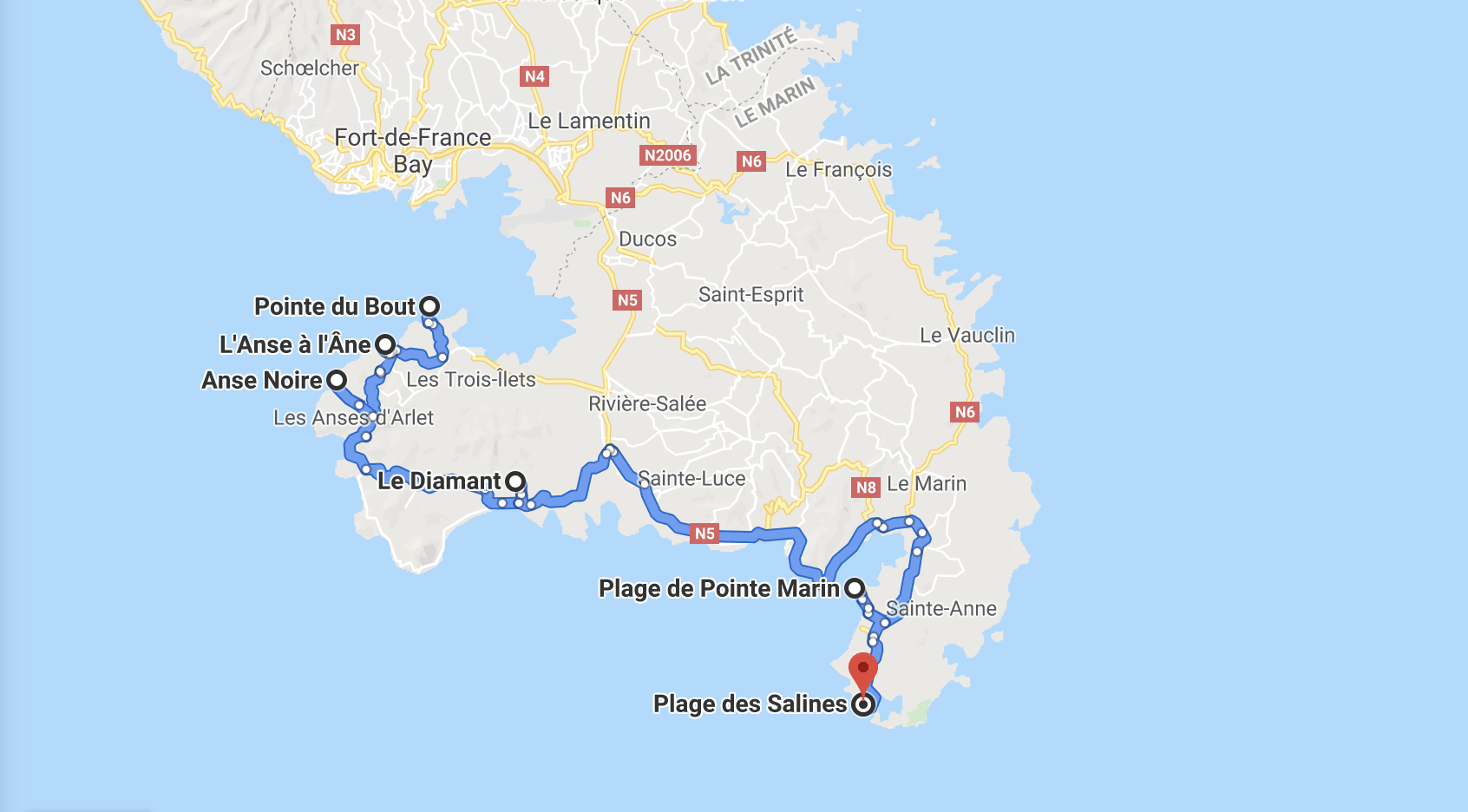
Martinique Road Trip Itinerary
From: Fort-de-france To: Plage des Salines, Sante-anne.
Stopped in at: Pointe du Bout (Les Trois-Îlets), L’Anse à l’Âne (Les Trois-Îlets), L’anse dufour and l’anse noire (Les Anses-d’Arlet), Le Diamant (Le Diamant), Plage de Pointe Marin (Sainte-Anne), Plage des Salines (Sainte-Anne)
Completed in: One day, but you could spend a few nights down at Sainte-Anne before returning.
Leaving from Pointe du Bout, an easy ferry trip from Fort-de-France and plenty of car rental spots to pick up a vehicle
Breakfast: Pointe du Bout, before you head off on your adventure has a few great breakfast restaurants & coffee shops, so eat here before you go.
Morning Beach Stop: Budget most of your time for L’anse dufour and l’anse noire – these are the highlights of this road trip and it’s worth basking in the maginificence of two such different beaches right next door to one another, and spotting the sea turtles.
Lunch: Le Diamant has a stretch of well regarded restaruants and is perfectly located for a lunch stopover.
Late afternoon: Stop in at Gros Raisin in Sainte-Luce to explore a charming little Martinique town with an intensely European feel. Or carry on to Plage de Pointe Marin to relax by the waves under the coconut palms
Sunset: Plage des Salines is the famous sunset spot, so grab a blanket and find a nice spot to sit, splash about in the water & watch the magnificent sunset display
Through the snaking maze of the Marrakesh medina, it’s impossible not to get lost the first time. Everything looks the same, and there’s very little to navigate around. Tucked behind a large heavy wooden door, unassuming and no different from the rest aside from the Riad Romance sign above the entrance way, laid our treasure.
A kind faced Moroccan man opens the door and welcomes us into a whole new paradise. I’m not the luxury traveller type, but when planning our trip to Marrakesh I had splashed out a little. This riad was a relaxing haven amidst the bustling medina.
The interior courtyard borders a central swimming pool with rounded edges, wrapped in glazed blue tiles. The walls a traditional moroccan style of chalky-painting in caramel colour with intricately laid brick facade stretching up a third of the way up. The doors are enormous, carved and wooden. Around the pool is a forest of gigantic pots, coloured in red, yellow, and blue filled with towering palms, banana palms, olives and oranges. Despite the hectic market life outside, the only noises penetrating the oasis walls are those of birdsong from above.
In the corner, a triangle couch clad in deep purple velour and brocade cushions all over. I drape myself over and admire the poolside around me as I sip sweet tea from a bottomless silver pot. Mosaic topped tables filled up the other corners of the space, and around the edges dangle multitudes of coloured lamps.
A small ginger kitten with a flowing tail is pouncing about the place, catching flies and chasing the shadows of birds that flit high above.
Frankensense burns near the pool, leaving a subtle fragrance that intermingles perfectly with the wafts of charring peppers and baking bread snaking out of the kitchen.
After a welcoming mint tea, the first of many, we are taken to our room. Heavy wooden doors open up to a slender, luxurious chamber. In the far left is a huge open fireplace flanked by two decorative, hanging lamps. The curtains are thick, soft gold with shiny golden stripes. The bed is soft, white cotton with velour golden pillows to accent. We have two large, maroon velvet chairs opposite the entrance way, and the floors are tiled in white brick with a large, soft, red rug over top. To the right side is the bathroom – a deep ochre with a large bath tub and small bottles of fragrant soap, shampoo, and lotion.
I feel like a princess with the softest sheets and warm stone tiled floors. The room around me softly lit with elaborate lamps.
The call to prayer echos across the rooftops of Marrakesh five times a day from all directions. A normal part of daily life for most, yet a surreal melody floating in the heavy air to those not yet accustomed to it.
I awake in the morning, rested and full of exploratory energy to a full breakfast beside the pool. Hot coffee gently spiced with cinnamon and served with steaming milk, devine homemade vanilla yoghourt, wedges of fresh mahrash bread, small pancakes with butter and jam, a plate of fried eggs dusted in bright red spices and a silver pot of mint tea.
The medina is a spiraling maze of golden, pink and red. Motorcycles and donkey-drawn carts whip by, and many locals still prefer a more typical dress code of light linen kaftans and pointy toed babushka shoes.
I eat myself into a stupor, frequently. The food is too good, and my self control too little.
Small rooftop terraces overlooking the jumble patchwork of souk rooftops serve up tagines, still bubbling and sizzling. Saffron chicken with olives and preserved lemon, spicy little marquez sausages in rich tomato sauce, couscous piled high with root vegetables, meats and chickpeas. All served with baskets of flat, semolina topped bread and dishes of local olives.
On the final night, a special in-house dinner was prepared. A specialty offering of the Riad. Glittering placemats were set upon the terrace as the large sun set over the rooftops. A feast of salads was laid out under the dusky sky – velvety eggplants, garlic courgettes, fresh moroccan salad, and herbed carrots with bread and olives. The main arrived – a sizzling tagine of lamb with plums, dried apricots and walnuts, followed by thin crispy pancakes layered with orange blossom water infused cream.
But, there are some dark sides to this mystical red city, and a stroll over to the main square of Jemaa el-Fnaa brings those to light. A lively hub of street foods and storytellers, henna painters and musicians. It’s a part of the city that really comes to life in the night, and feels like a tip-toe into ancient Arabic lands, far flung from modern day Africa.
With each step through the medina a new voice comes, ‘you’re going the wrong way!’, ‘It’s closed!’, ‘You can’t go there, it’s forbidden’. None of this true, of course. But a popular Marrakesh scam involving helpful people, tour guides, and extortionate fees.
After another quick whip through the souk, filled with a lifetime of treasures, lanterns, and spices; the space opens up to the large square of Marrakesh’s famed Jemaa el-Fnaa. The unmistakable whining of pungi fills the air – snake charmers are all around. An ancient trade I once considered mysterious and exotic, turns out to be a horrendous exploration of creatures and tourists alike.
The snakes, mostly cobras, are hunted from their holes further out in more remote parts of the country. Many have their teeth pulled, or other methods to make the creature less dangerous. Once captured, the craft of charming them is less and art form, and more a practice in maintaining the perfect distance to keep the snake permanently on-edge, yet not quite close enough to strike. The snakes don’t last long – the stress means they die quickly, and within weeks the charmer will need to head back out to the desert to find a replacement.
Many of the snake charmers in Jemaa el-Fnaa will act in accordance to the tourist – if they spy fear, they will drape the cobra over the unsuspecting victim, demanding a fee to remove it. If instead they catch even a hint of curiosity, they will swarm around offering photo opportunities – for a charge, of course.
Weaving our way through the busy square, paying extra-careful attention to avoid making eye contact with any snake charmers and leash brandishing monkey handlers (if you worry for the snakes, I won’t even start on the monkeys) we made our way back into the relative calm of the medina, and on to our delightful riad.
In the end I fell asleep in our little palace, full and contented, somewhat haunted, and ready for further explorations from Marrakesh out into the South of Morocco.
Some countries are interesting to visit, a nice place to spend a little time. Others, a very select few, are more than that. They feel like another home, somewhere you were always meant to wander. Unexpectedly, this is how Morocco has taken me by surprise. From the fragrance of the spices, wafts of smouldering frankincense, the sounds of the adham, and the bustling souks full of Aladdin’s caves full of flickering lamps and donkey carts.
Stepping out of Aimé Césaire International Airport is an experiment in vacation imaginations being allowed to run amuck. The road to Fort-de-France is fringed in a mess of coconut palms bobbing in a sky heavy with humidity; colourful Caribbean houses painted in pinks, yellows and pale blues teeter on the hilltops; and large French chain stores line the side of the highway.
What happens when you place France on a small Caribbean island? As it turns out, the result is Martinique. It made sense to get away for December, hide from Christmas, and wrap up a year spent in North America by dipping my toes back into some warm sand. Martinique had started as a bit of a joke destination – somewhere exotic and far-reaching, that I knew so little about.
Yet quickly enough, as these things tend to do, I found myself with a flight bound for Martinique, leaving from a very wintery Montreal.
Martinique is part of France
Martinique is a French overseas territory. This means it is not just French reminiscent, but by visiting you are entering the country of France on arrival. The official language here is French, and the currency is the Euro. Stepping into downtown Fort-de-France is a colourful and vibrant reimagining of mainland France where boulangerie meets coco rum punch, and market stalls are overflowing with mangoes and papaya.
Many airlines offer direct flights from mainland France each day, making Fort-de-France a uniquely popular spot for French tourism rather than the hoards of North American tourists who more frequently find their way to other neighbouring Caribbean islands. Cruise ships do stop by, bringing a frontline smattering of harbour-facing souvenir shops opening only when the ships dock, and leading to sporadic days of heightened tourist activity around the small downtown area of Fort-de-France.
Fort-de-France Food
Being France, this is one of the best spots in the Caribbean to find excellent French wines; and boulangeries laden with croissants and local breads with a coconut twist. Varieties of Bordeaux wines stock the shelves alongside an abundance of island produced rum, and if you look hard enough you will stumble upon the occasional typical French bistro serving entrecôte, ratatouille, magret de canard and creme brûlée.
More typical Caribbean food is a staple here too, with cassava and plantain dominating alongside Colombo de poulet – A chicken curry that arrived with Sri Lankans who were brought over to work on the sugar plantations. The food found here is a fascinating blend of traditional French, African, Creole, South Asian and a wide variety of local seafood.
December didn’t prove to be a great month for local fruit, with most of the delicacies of mangos, guavas and pineapples falling out of season. The markets still stocked fruit, however most varieties we got our hands on were under-ripe, poor quality and sadly out of season. However, if you come here during mango season (May to July) the island is heaving with an abundance of the fruit around every corner, and with most of the rural roads lined in mango trees, it makes for delicious roadside mango collecting by the armfuls.
Language Barrier – Do they speak English in Fort-de-France?
The information I’d found about Fort-de-France hinted at not a word of English spoken. Fine by me, my French is enough to get by and practicing the language was a large part of the reason for visiting. Yet, I found much more English spoken around than I’d expected.
While it’s true that French is very much the primary language of both locals and tourists alike, the experience of having people move to English where they could was accomodating and kind. I didn’t encounter any place where there was not even a word of English spoken around Fort-de-France, and I suspect an English speaker who attempted just a few words of French in practice would find themselves understood, and able to get by just fine.
I, on the other hand, wanted to practice my French while here and tried with great determination to avoid switching to English. I found most everyone I spoke with to be patient and understanding, helped with correcting my use of the language and the accent and dialect (to me, at least) felt very similar to mainland Europe French, so I could understand most people without great difficulty.
Fort-de-France shuts up shop in the evenings and on Sundays
Just like on mainland France, supermarkets close on Saturday midday and stay closed through Monday morning. Fort-de-France although lively and bustling during the day, becomes a ghost town at night.
Spending time in this city is much like many other European small towns, and involves some time and planning to get groceries in advance of the weekend, and learn which spots will remain open and when.
Most restaurants also close in the afternoons from around 3 – 7, with many not opening beyond lunch at all. Eating out in Fort-de-France was a careful lesson in always checking opening hours, and never assuming anything.
Where we slept & where to eat in Fort-de-france
We stayed at Patio Gallieni who offered a lovely, clean and very central apartment with cooking and laundry facilities in the apartment (a rarity in this traveling life!) It’s far from a tropical beach resort, but is an awesome option if you want to be central in Fort-de-France and not require a car for the every day.
Grenade et Basilic was the highlight of French food in Fort-de-France. Various review sites place this charming restaurant far down the ranks from where it deserves to be. The owner is delightful, the food is very French, and I especially loved the house made ratatouille, entrecôte, and the varying daily crème brûlée flavours. Extra bonus points for being open on Sundays when most things are closed, this restaurant became a weekly tradition during my time here.
Some other honourable mentions for Fort-de-France food were Le Taj for being a lovely change of scenery and pretty good Indian food, Hasta la Pizza for being open frequently, with affordable good pizza and cold wine looking out to the harbour, and Design Pastry for being a reliable source of delicious pastries, decent coffee, friendly faces and a sunny space to sit in the mornings.
As ancient Chinese legend would have it, here in the Sichuan region of Southwest China there was a fierce dragon lurking in the Minjian River, a 735-kilometer-long tributary of the famed Yangtze River that we were visiting from nearby Chengdu.
After a complicated journey involving a luxuriously sterile bullet train ride, followed by a slightly bewildering bus trip, we finally arrived – well, that is to say, we were either at Mount Qingcheng or the Dujiangyan irrigation system. Both historical sites are in a similar area surrounding the Minjian river, and our local bus gave little indication as to which stop I had arrived at.
We were later to discover that it was the Dujiangyan irrigation system that we had reached.
Dujiniang waterway
The expansive waterway of Minjian bisects the modern from the ancient – on one side, the city of Dujiangyan. On the other, the Guanxian ancient city. Laid down as far as the eye can see is a visual feast of flowers, trees, and monasteries. Pagodas teetered on the cliff faces and each turn reveals a manicured Chinese garden, robed monks lighting joss sticks with craned legs practicing tai chi.
One of the great technological achievements of ancient China, Dujiangyan has prevented yearly flooding and served for almost two and a half thousand years of irrigation. Implemented first in 200 B.C, the irrigation system still provides a major source of water for many fields and farmers in China.
This impending mythical crisis was unfurling at the time Governor Li Bing began construction on the Dujiang Weir. The man and the dragon were at odds, fighting over the river construction. The governor was displeased. Not to be outdone by the bellowing, ferocious dragon, he arranged for an opulent feast – an excuse to meet and negotiate with the fearsome beast.
Sketch map of Guanxian Ancient City
Yet, the dragon, as dragons have a tendency to, did not arrive on time – sending him into a furious rage. He became so angry that he transformed into a rhinoceros and plunged into the river to battle. They fought tirelessly in the foaming waters, neither losing ground. Eventually, Li Bing returned to the platform and tied a ribbon around his waist before returning to his opponent. He instructed his soldiers to shoot arrows only at the dragon, telling them he would be identified by his ribbon.
They succeeded in the end, shooting and killing the dragon in the river Minjian, giving a name to the Fulong Temple, meaning subdued dragon in Chinese. And here we stood, on the Douxi Platform overlooking the magnificent Dujiangyan irrigation systems and down the hill slopes, decorated with ornate pagodas and cherry blossom trees right to the Minjian’s edge. It was hard to imagine being anywhere other than an ancient land steeped in a rich mythological heritage.
Wind chimes tinkered in the distance and the courtyards and hillside walkways ambled through ancient temples and the perfect setting for an ancient kung fu story. Visiting Dujiangyan waterways is less a tourist escape and more a practice in time travel.
Pagodas and potted trees
Bonsai at Dujiangyan
Wandering the Dujiangyan hillsides
Archways in Dujiangyan
These areas are home to the Panda Village in Pixar’s Kung Fu Panda 3, and if you travel across to the nearby Mount Qingcheng you can visit the precise temple it was modeled upon.
After many hours meandering and exploring, taking in the breathless beauty of a truly ancient place, we found ourselves back at ground level in the Guanxian ancient city on the banks of Minjian. Built around a 340m long street which begins at the Songmao Ancient Path, this town has been an important regional jade market for more than 3,000 years. The ancient Shu people unearthed Xiu Jade from the Minjian river to be turned into sacrifices for their gods. Guanxian Jade is popular across the world, and during the ancient cities more prosperous period, it was home to dozens of different jade shops. Now it has been done up to capitalize mostly from tourism, however, they’ve done so in a way that still maintains the traditional feel and authenticity of the area.
Forested Pathways at Dujiniang
Bonsai overlooking Minjian
Misty tunnels
After a thoroughly enjoyable day spent negotiating local Sichuan buses, exploring vast hillsides of ancient history and devouring candied fruits in the town below, we made our way back to Chengdu to spend our final days exploring the Sichuan capital.
We eventually left Chengdu by an overnight train bound for Xi’an around noon, arriving at the central train station early with time to spare. The station entrance is located in a large square populated by touts & hawkers, bordered by convenience stores and low-grade restaurants. We choose a restaurant at random, but the C food grade rating complete with red, sad face should’ve been enough of a warning to try elsewhere. The owner took only one order from both of us, then returned with two of that, leaving me no chance to order. I sent my dish back, and once again was not able to order. The food quality was bad and in the end, we paid our bill and left. I didn’t want to try my luck twice so immediately headed to one of the many convenience stores to pick up snacks – prunes, ramen, and snickers to eat along the way.
The curious thing about train stations in China is the sheer length and number of queues you must stand in. The first, on this occasions, was the longest and we waited to enter the x-ray + pat down area. Once inside, we were to find which waiting area our train left from – an area full of seats, although none free and bordered by restaurants, McDonald’s, and yet more convenience stores. Soon it was time to board, and we were to stand in another long, snaking queue along with the rest of the passengers for our 19-carriage long train.
Train from Chengdu
Tiny notices about the place
We were hard sleeper class, the cheapest sleeper carriage with 3-high bunks in 6-bed open berths. Much more comfortable than the Indian equivalent, and not sold full of people either. We were on the bottom berth, with excellent large windows and a small table between us. The countryside was beautiful – many yellow flowers, hills, valleys and mountains, some cherry & peach blossoms passed our views. We got to see many small towns with great scenery and questionable Chinese architecture, tons of factories, massive overpasses, log mills and many abandoned buildings. It was a very relaxing journey and we enjoyed wonderful views and a comfortable ride on to our next destination of Xi’an.
The drive into Chengdu was like a movie set in modern-day Tokyo. Everything in a foreign script, flashing lights, neon signs and the bus driver riding the horn the whole way. By sheer luck, we disembarked in the centre of the city. The rest of the evening passed walking in the cool air through the downtown Chengdu, admiring the amazing buildings and Chinese feel of it all. Very clean, very relaxed. Nothing like I’d expected. Once we had completed the expert challenge that involved finding our hotel, we unpacked our things and set out for a late-night dinner.
The Sichuan cuisine of Chengdu fascinates me, and as a lover of particularly spicy food, I was hoping to find myself in food heaven. We settled on a small restaurant with an illegible menu (as they would all be). A friendly group welcomed us in, but a hostile owner was not too happy about our arrival, yet served us up a plate of pork and green peppers, none the less.
After some rest and recalibration, we set out to explore Chengdu. I was finally in my fathers China. A surreal and unusual realisation of bittersweet joy and curiosity. A sub-provincial city in the Western region of Sichuan, Chengdu is known for two things: fiery red cuisine and pandas. A city far removed from its busier siblings, I was to find none of the over-crowded mania most visitors warned of.
Chengdu – flashy, modern & clean
It came as no real suprise to find ourselves in a city where nobody spoke a word of English. Where flocks of businessmen skimmed past on yellow rental bicycles, briefcases in the baskets, dinging their bells as they passed. Chengdu was a bright and happy city, a rare find. 14 million inhabit this sprawling metropolis.
A city full of matching condo buildings, train stations and bustling malls. It was a unique opportunity to explore a country in such an authentic way. Somewhere unblemished by the Western tourism that plagues and transforms the more popular cities. The touting is very minimal, as we passed people in the streets they took pleasure in saying ‘Hello’ with beaming smiles, practising the very little English they knew.
Yet, dear readers – to understand and experience the city of Chengdu one mustn’t take it at face value. On wandering the streets you might notice a distinct lack of street food and hole-in-the-wall eateries. You know, the kind that spring to mind when uttering the word China. Don’t get me wrong – it exists, but not in the swarms I was hoping for. This is partly due to a recent ‘clean up the straights’ bylaw that was targeted towards getting the vendors off the roads. It is also because you’re looking at entirely the wrong level… For this exploration, we had to head underground.
Streets of downtown Chengdu
The mysteries of the Chengdu tunnels
In my travels, I have yet to experience anything quite as post-apocalyptic sci-fi as the unusual tunnel land that was to greet us in Chengdu. The tunnels of Chengdu are not like anything I was prepared for. Not mentioned in the guidebooks I read, nor something I have encountered much elsewhere in my travels. I never quite came to understand why – perhaps the summers are too hot, the winters too oppressive? Maybe people prefer a life spent underground? For whatever reason, almost all the interesting discoveries we made were at least a few meters under the earth.
The first land of tunnels we stumbled upon looked like the entrance to a metro station opening. Yet, there were many of them spaced 150m apart down the entire length of the street. An unusual expanse of derelict underground lands unfolded in front of us. For long stretches, the storefronts were uninhabited and abandoned. The ones still holding on? Lonely islands stocking underwear or iPhone cases, the owners glued to their soap operas like captains of a sinking ship. It only took one descent into this absurd wonderland to know that we would be back again.
Entrance to the underground worlds in Chengdu are dotted all over the place.
Tianzuo Shangcheng Entrance
Another Diyi Dado Tunnel Entrance
So many tunnels, but why?
That night I toiled away on Baidu. China’s answer to Google in a land where most websites are censored, to see what I could discover of this underground discovery. As it turns out, Chengdu has had an elaborate system of underground passages long before even the metro was constructed.
They were known as the Tianzuo Shangcheng, and date back for over 40 years. Back then it was home to many shops before business tapered off and the entire complex was closed. This was while the first Metro line construction began.
In 2010, the land of tunnels was to be given a revamp. A hefty sum to the tune of 289 million yuan was paid for development rights, and this large 40,000 square meter network of tunnels was to be given a facelift. The final shopping centre was to total 90,000 square meters and become known as the Diyi Dado (????). Part of a grander scheme of underground shopping districts across the country.
The mysterious tunnel lands lie multiple layers deep, connected by escalators.
A series of abandoned projects
As with many, if not most, things I have discovered in China; new projects start with a fanfare – a huge pile of money and a lot of promise. Most dwindle away into incomplete renovation projects, lost amidst the capitalist maze of Chinese construction. The promises were grandeur – connections between many downtown buildings, rainbow passageways leading to 24-hour shopping centres. The area around Tianfu square appears to be a spectacular success, resembling more of a modern-day Tokyo than much else.
Housing modern shops, expanses of arcades and restaurants with as many as 10,000 merchants vying for a storefront space on opening day. Today it is home to many of the unusual nuances across China. The aptly named ‘A La Fried Dumplings’ which, does not sell fried dumplings at all. The fast food ‘Happy cat’ haunts me – it’s probably not cat meat, but why the happy dancing kittens in the video?
A deserted, underground wonderland
It is in the tunnel lands further afield, a short stroll away from the Tianfu hype, that things get interesting. Large stretches of an abandoned mall with large chunks deserted. The majority of remaining stores house hair salons and underwear stores. There are a couple of small restaurants, tattoo parlours and plenty of iPhone covers to be coveted.
Down the far end, completely abandoned. There is an area with the walls painted to be Parisian, welcome to Paris, it informs. Another stretch painted with tulips & windmills claims itself Dutch. Eventually, we arrive to the sea life-themed tunnel. A deep underpass decorated with fish and undulating blue neon lights, the paint peeling, and eerie music coming from a worn speaker in the corner.
Inside semi-abandoned Chengdu Tunnels
Traditions and Cuisines of the Sichuan Region
Up above the tunnel land, spring is taking hold and rural China is alight with bright yellow flowers. In the city, there are many displays of plastic yellow flowers and fake peach blossom trees, the most popular selfie haunt in town. We enjoy a rare moment of clear skies and sunshine to see what culinary delights might await. Chengdu is famous for being spicy, thanks to world-renowned Sichuan peppers. They add a noticeable citrus flavour & numbing mouthfeel that is omnipresent across the region.
Karaoke booths were always popular
Delicious Sichuan Cuisine
Due to a series of misunderstandings, bad translations and planning errors we never managed to sample the famous Sichuan Hot Pot. In the centre of the table lies a bubbling caldera of spicy hot broth to dip your chosen skewers, poaching them in lava until done. The skewers range from simple vegetables to more complex items such as intestines pulled from a live duck, or a pig’s stomach lining.
Chengdu, A city famed for Pandas
But there’s no disputing Chengdu’s true claim to fame, one you will see reflected in every second shop window. The region of Sichuan is the native home to China’s most beloved mascot, and provides many an opportunity to admire, and even volunteer with pandas if you’d like. If you were ever in dire need to outfit your home, restock your wardrobe and dress your child in panda-themed gear, the shops in Chengdu would be a good place to start.
The city also happens to be home to the largest panda research base in the world. Located in what used to be rural Chengdu, it has been devoured by the expanding city and is now in an outer-city industrial area. But, you wouldn’t know it once you get inside. Well-kept pathways lead through towering bamboo in this massive, immaculate park. Trails lead to museums, exhibits, the research centre itself and of course, many pandas of both the giant and the red variety.
Being one of the major tourist attractions for panda lovers worldwide, it should come as no surprise to learn that with one wrong move or miscalculated step in planning, you will find yourself sandwiched between tens of thousands of tourists. You’ll be unable to see the pandas because they hate rampant tourism as much as I do, and choose to hide away and nap during the park’s peak hours.
Visiting the Chengdu Panda Research Base
Carefully we plotted our visit, catching an early morning local bus and utilising GPS to establish the correct stops. Arriving 15 minutes before opening time, and we were relieved to find only a handful of other die-hard panda fans who had the same idea. We waltzed ourselves in, the fourth and fifth visitors on this day, and made our way straight to the pandas.
Many hadn’t been let out yet and were still milling about in their sleeping quarters, munching on bamboo and pacing about waiting for playtime. We were mere centimetres away from them, separated by a glass window. I’ll be honest with you here – the first panda I spotted looked so fuzzy and had such round teddy bear ears that I couldn’t tell if it were real or a picture. Then it moved. I was rather taken by how unreal they look.
An inundation of tour groups
Throughout the first hours of the early morning, there were few people, and we enjoyed most of the exhibits to ourselves. The pandas were playful little clowns and enjoying breakfast time. The cubs rolling about their mothers and doing headstands in the trees.
By 9.30, there was a dramatic change in the landscape. School groups, tour groups, masses of undulating people everywhere. Claustrophobics nightmare. The pandas were gone – hiding in their huts, in the trees, pretty much anywhere to get a break from the crowds. When people on Tripadvisor complain of the pandas being hard to see or asleep, this is why.
Amidst the flurry of culture shock and Sichuan peppers, of tunnels and giant pandas, Chengdu provided a glimpse into a side of metropolitan Chinese life that I was not to find again in my travels. With an awareness that we were to experience China in this way for the last time on this journey, we bid farewell and boarded an overnight train to Xi’an.
As we departed the Phuket region of Southern Thailand bound for Ao Nang, I couldn’t help but wonder if I’d been grossly mistaken about this entire corner of the world. So far, nothing in Southern Thailand had been as expected. Even the 6 hour bus journey, which I would usually dread, was deliciously scenic & suspiciously comfortable.
Finding the right bus was unusually simple, devoid of pushy touts and tourist scams. It only took a public songthaew over to the second bus station, then picked up a cheap ticket all the way through to Krabi town. The ride took a breezy half-day and the vista was punctuated by towering limestone karst formations and tropical jungles. Moments of awe and tranquility were still punctuated with those of loss and sadness, this was still early days in the journey and my family were very much on my mind.
Views of Tonsai, Krabi
Railay Beach, Krabi
Krabi is one of those places that seems to breed the most contrasted of reviews. On one hand, so many recommended it to me for it’s tranquility, chilled out atmosphere and easy way of life. On the other, close friends were convinced I probably wouldn’t enjoy much of it, and that it was crawling with tourists. I suppose visiting in the shoulder season made a considerable difference, and that this region in the height of summer-season mania is perhaps a horrifying beast in comparison.
I would love to compare Krabi town to Phuket town, as they are both the inland transport hubs of a region, however as we only spent one relaxing night here, and out of the center at that, I can’t comment. What I can tell you is that we stayed in a gorgeous little hotel on the outskirts of the city, flanked by local restaurants serving real Southern Thai food by kind-hearted locals who spoke only Thai. Nothing like the resort towns of the islands, that’s for sure.
After a morning sunset through our panoramic, bedside, wall-length windows (which was about exactly as wonderful as it sounds) we made our way out toward the street to hitch a song-thaew to the seaside town of Ao Nang. But not before the charming hosts wrangled us into a group snap to thank us for staying and share on Facebook. As luck would have it, the regular song-thaew route passed right by our rural road and in no time we were on our way, crammed in tightly with additional passengers hanging off the back and our backpacks dangling precariously on the rooftop.
Beachfront Cafe, Ao Nang
Ao Nang is the biggest town amongst a smattering of those kind of places I imagined only existed in postcards. You know the ones – clear turquoise water, white sand beaches, colourful long-tail boats and monstrous limestone cliffs. The weather is hot and the water is bath-like, a multitude of reefs and coves make for some of the world’s best snorkeling.
Our time in this Thai paradise was split between the two far ends of Ao Nang beach, each a tranquil haven compared to the more tourist-focused main strip of the town. Our first home was a traditional bungalow, set amongst a small tropical forest – an easy 10 minute walk from the beach but a little further to eat. The closest waters were at an inlet, with less water movement than the main beaches making the ocean a little too hot and not at all refreshing for a dip. None-the-less, there were plenty of pine trees to tether a hammock and many a lazy afternoon was spent sipping coconut shakes and reading novels to the sound of the gently breaking waves. After a week we migrated over to the other end – and into a spacious, modern studio apartment in a rather gorgeous hotel complex. Spectacular cliff views and two stunning pools complemented our beautiful room. Perhaps I could’ve happily lived out much of my life right here, just like this.
Ao Nang life was an idyllic dream. My first real sense of acceptance and relaxation in this journey. A destination that on completion led to months of separation anxiety and daydreams of returning sometime soon. It made a lasting impression on me.
Sunset Boat Trip, Krabi
Limestone Karsts from a boat
Ao Nang shares a number of smaller neighboring beachs, including Ton Sai and Railay. Despite being adjacent beaches, the steep cliffs and dense vegetation mean that the best way to reach next door is by catching a long tail boat. They leave frequently and the fare is reasonable. The process is simple – buy a ticket, wait on the beach until your boat is ready, then wade through the ocean, hoist yourself up & find a place on the wooden-plank seating.
Ton Sai arrived as if imagined from a novel. A hippy-come-rockclimbers utopia of magnificant climbing rockfaces and wooden beach hut housing. A short stroll uphill from the shoreline and you’ll find a selection of uber chilled cafes and book exchanges complete with mandatory hammocks for when such a need arises (and that it does here, frequently). Perhaps not paradise for remote workers however, as most of the area is powered primarily by generator and the WiFi (and air-con, for that matter) is sporadic and often switched off during the daytime, when – let’s face it, you should be at the beach anyhow.
Railay is located one more bay over, and in many ways is the anti-Ton Sai. Instead of spotting slews of chiled out climbers napping and chowing down on pineapple curry, Railay provides more of the resort front. More swimmable beaches are to be found thanks to a much sandier bay, and oceanside massages can be found for about twice the price of back in Ao Nang. Visitors queue for cold fruit shakes and alternate between relaxing in the perfect sands and hot-footing it back into the perfect ocean to refresh.
Ao nang, my love.
The next time I laid eyes on these magnificent beaches I was on a pirate ship, cleverly crafted out of a traditional Thai Junk, and it took a tour around the most beautiful waters, reefs and beaches in the area to enjoy a full day, evening and sunset exploring. We snorkeled with clown fish and backflipped off the top deck into the crystal clear waters. Millions of bats flew overhead as we watched the sunset and the evening was capped off with a magical snorkeling visit into the dark, night time waters with bioluminescent plankton, an experience akin to swimming in a sky full of stars.
The perfect ending to an unspeakably magical few weeks, and one that re-shaped everything I had thought I knew about Southern Thailand. Next stop? A train journey up the length of the country to spend some time in Bangkok.
Propelled from an ancient city into a space-aged modern one at the blink of an eye, Bangkok has undergone many changes in recent times. What was once a city of floating markets and traders of spices and silk is now a global tourism destination. A sprawling metropolis set against a futuristic landscape of skytrains and megamalls.
Once, the Venice of the Orient
The floating markets and canal-boat transport that once defined Thailand’s capital were born out of necessity. The relentless flooding of the long, wet season would turn the city into a swamp, rendering land transport redundant. Nicknamed the Venice of the Orient, for the longest time Bangkok was primarily accessed via the khlongs.
Due to the atrocities of cholera, the development of modern roading, and the modernization of Bangkok, many of the original khlongs are now unused or filled in. But on the side of the city known as Thonburi, you can still catch a glimpse of the old, romanticized orient. A glimpse of a land somehow left behind by the modern age. A place where floating markets are commonplace and breakfast is spent watching the world glide by from your rickety, stilted river-house.
Being somebody who hardly ever settles for what regular tourism has on offer, I rejected the idea of another boat ride down the Chao Phraya River. Not that there’s a problem with that of course – but I yearned for something out of the ordinary.
Exploring the Khlongs
My father didn’t travel for most of his life, it wasn’t until I was a teenager that he travelled to China for business. From that moment forward, he developed an insatiable, and contagious wanderlust. His love of travel was never directed at the kind of places one might find on a tour, much like my own, it was quite the opposite. He enjoyed the nuances of every day – scanning the shelves of a foreign supermarket, or walking in the suburbs admiring the different types of trees. I inherited this curiosity from him, and the small canals of Bangkok came up every time he spoke about Bangkok. When he told stories of the khlongs it was as if he had discovered a secret doorway into the life of a more traditional Bangkok.
Without him around to tell me any further, I was now on a mission without a guide. Where were these canals? How was I to explore one?
It took only a little research to uncover the Khlong Saen Saep express boat. Local transport that stretches from the very innermost end of central Bangkok out into suburbs of the city. It stretches out to corners so quiet that you feel you must have fallen asleep, only to awake in a tiny rural village.
Finding a boat, choosing a route
It became clear the only reasonable solution was to embark at the midway mark closest to where I currently was. From there, follow the khlong to its most far-reaching stop, and then turn around the full length of the canal – if only to see what was at the other farthest end. For some, that seems a lot of travelling, with little destination in mind – but sometimes the journey is what it’s all about. I needed to sit and watch, to find out exactly what it was my father raved about so very often before his death.
From end to end we spent the day exploring, wide-eyed and in awe of a new face to a city I thought I had known. The khlong-side cafes and city-stops gave way to unreal local neighbourhoods, rickety housing balancing on poles and parts of the city so devoid of traffic noise that the only sounds were miner birds and the splutter of the passing boats.
The route passed by ornate, gold-leafed wats where orange-robed monks bathe and laundered in the tiny canals branching off to the sides. The retaining walls housed colourful street art and rambling vines. Side-by-side floating houses dangled with hanging laundry and riverside restaurants heaved with hungry commuters.
Return to the Bangkok bustle
Coming off the central Phanfa Bridge after a full day on the water, I snapped back into modern day Bangkok at the hiss of touts and splutter of tuk-tuks. It had been a dream-like trip into a more suburban and rural Bangkok, and we stumbled bleary-eyed back into the midst of the chaos to find a good meal.
Visions of mango rice and fresh, hot pad Thai danced in my head. But, after a series of street-food indecisions and severe lack of phone battery, it was beginning to get late, and everyone was starting to pack up. We had wandered for quite some time now without finding any real clusters of vendors, and I was giving up hope that we would find somewhere good to eat. In a last-ditch attempt, we spotted an alleyway restaurant that still had quite a few groups.
Delicious dining down hidden alleys
What we discovered still baffles me to this day. A large establishment, taking up both sides of the alleyway. An overbearing yet delightful Thai woman sat upon her pedestal, watching over and commanding staff about the place.
The food was exceptional. I gorged on spicy red duck curry with fresh lychee and pineapple, and crispy spring rolls as I contemplated the day passed.
As we sat and enjoyed a spectacular meal in the most unexpected of places, cars passed down the alleyway. Every single one a shiny, new model with blacked out front windows and a single dressed up woman in the backseat. The alleyway leads to nothing, and the whole scenario screamed of some bad gangster movie.
Whilst marvelling at the unusual activity, I spotted a police car sat in the middle of the main road in silence, lights flashing, doors open. As if the only purpose was to consolidate everything I already knew, that Bangkok truly is a city of infinite mysteries.
There is nothing quite akin to the pleasure of stumbling upon an incredible new destination completely by accident, and with the amount of research I indulge myself in, it’s a rare find to be completely blindsided by somewhere. But tucked away just out of view of Phuket International Airport, I was delighted by Naiyang Beach.
After a number of years of travel in and out of Thailand, I had never before ventured to the Southern corners. Visions of relentless Tuk Tuk drivers and over-crowded, over-priced tourist nightclubs pervaded, and many plans ended up changed. Permanently scarred by a rough and budget whirlwind visit to Kuta Beach Bali a number years ago, I’d been in no hurry to repeat.
Sunset swim at Nai Yang, Phuket
I have no doubts that parts of Phuket Island,most notably Patong Beach, are more like the Phuket I was imagining. Despite having lived in Thailand before, coming to the South felt like discovering an entirely new country where I got to reimagine an entirely new side to a country I am hopelessly in love with.
Research, however, is not exactly how I stumbled upon Naiyang. We were simply seeking a quiet place, close to the airport to rest our heads after a day of flying. Nai Yang is right next to the airport, and one of those rarities in Southeast Asia – laid back, small-town, gorgeous beach, exceptional food and plenty of sandy spots to watch the sunset.
Tom Kah Gai in Naiyang
Phuket island spans 576 square kilometres and is made up of the largest island in Thailand, as well as 32 smaller islands fringes with Andaman Sea shorelines.
A night was well spent in Naiyang paddling in the clear waters and looking for a tasty meal. After wandering past the decidedly more tourist-orientated seafood joints, we found ourselves at the end of the ane, sitting in a small restaurant looking out to a karaoke bar. Over the fence led further afield to derelict condos and overgrown scrub. The super friendly lady with excellent English served up one of the best tom kah gai’s I’ve had to date. The visit was delightful, and far too short.
The next morning it was time to make our way toward our final destination of Ao Nang, a trip we had to take via Phuket Town. We opted for the cheap and easy government bus to get there. It took a little bit of research to understand this bus system – one that seems to be kept just a little out of reach from tourists. For a start, you can only catch it from the domestic terminal, meaning that any international arrivals will not instinctively see it, and will instead be whisked away into the chariot of a completely overpriced taxi or tour bus service. It took around an hour of driving through gorgeous little Thai villages and tropical forests before we reached our destination: Bus Station #1 in the heart of Phuket town.
Exploring Phuket Town night markets
Much like Phuket region itself, Phuket town was somewhere I had very little previous knowledge of. In fact, simply the word Phuket conjured up images of drunk teenagers of the Australian persuasion and relentless touts pawing at my wallet. And, much like in Naiyang, I was horribly mistaken. Once again, Phuket town is the central hub – it is a place to transit out to the islands and party beaches of the region. Phuket Town is absolutely charming. We found an abundance of excellent, cheap food and interesting markets to walk about, the accommodation was affordable and we scored a spot right next to the bus station, all ready to depart again tomorrow enroute to Krabi.